
Efficiency got us this far.
It won't get you any further.
Nineteen minutes, a whiteboard, and the honest case for why the entire cybersecurity industry has to rethink what it's optimizing for.
Recently, Netenrich CEO, Raju Chekuri, spoke to an onboarding class for new Netenrich employees on our approach to Autonomous Security Operations.
“You have zero chance to stay protected if you live in the known world. Period. Doesn't matter who you are - a JP Morgan or a $5 million startup.”
- from the talk, on why Pre‑LLM tooling can't hold against Post‑LLM adversaries
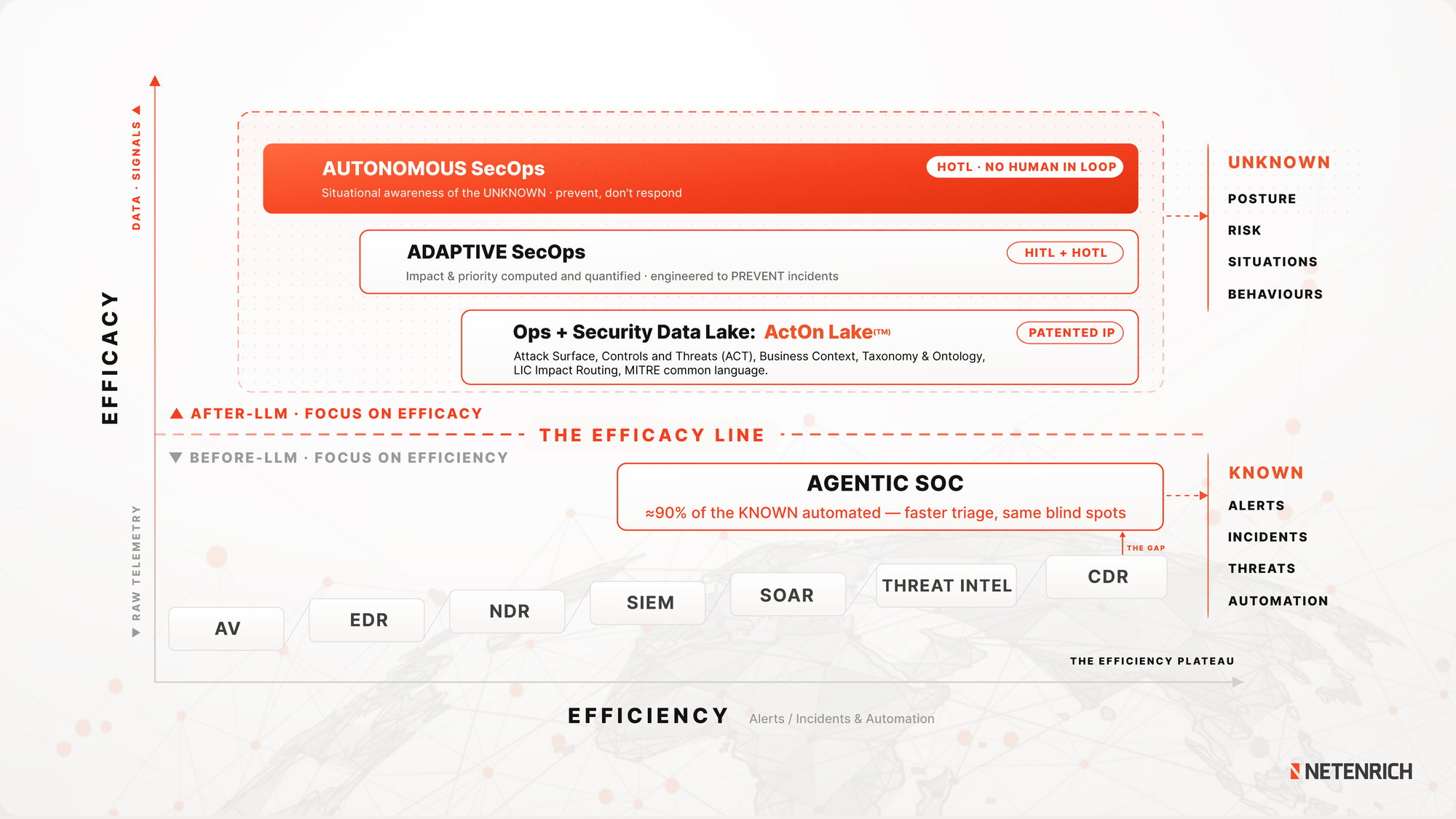
Two axis. Everyone's stuck on one of them.
Every tool you've bought lives somewhere on this chart. Antivirus thirty years ago. EDR from Microsoft, CrowdStrike, SentinelOne. NDR. SIEMs like QRadar and ArcSight. MDRs, XDRs, outsourced SOCs. Threat intel feeds. Attack surface tools. Almost all of it optimizes the same axis: efficiency — doing more, faster, with what you already have.
Almost none of it moves the other axis: efficacy — whether any of it actually holds against a real adversary. That's the axis that matters to your board, and it's the one the industry has quietly avoided measuring.
Point tools, linear process, treading water.
Every generation of tooling solved the same problem the same way: alerts in, tickets out, L1 to L2 to L3. You're writing rules, running parsers, layering on user-behavior analytics. It's an entirely incident-based world, and the whole game is efficiency — driving down cost, managing outsourcing, keeping your head above water.
That's not a criticism. It made sense. We all lived through it, myself included. But it's table stakes now, not a strategy.
Agentic SOC on a legacy engine is still a legacy engine.
Everyone's calling themselves "agentic" now — 90% of any trade show floor. But most of it is the same linear, known-world problem with a faster wrapper. Meanwhile the adversary already made the real shift: they have deep intent, they run multiple campaigns at once, and they're not waiting for something to look wrong before they act. One person with cloud resources and an LLM can do what used to take a team.
You have zero chance to stay protected fighting that with Pre-LLM tools. It doesn't matter how big you are.
You shouldn't be paying a team to do this.
Every time we sit down with a potential customer, they want to know how good we are at the basic blocking and tackling. Our answer: you shouldn't have to care. That layer should be 95% automated — by design, by intent, by the right tooling — not something you're staffing and budgeting around. That's what frees up the conversation for what actually matters: are you prepared, and what do you fix first.
You can't control what you haven't defined.
If an organization doesn't know what assets and entities it has — and which ones actually matter — we don't know what to control. And if we don't know the right controls are in place, we don't know which threats are actually relevant. That's the whole idea behind our ACT Framework: Attack Surface, Controls, and Threats.
We start bottoms-up — not a static CMDB or a spreadsheet, but a living picture built from logs, identity, and behavior, because your attack surface changes every day. An employee leaves. A new vendor signs on. Someone spins up an agent nobody approved. All of it is surface. All of it has to be operationalized into one source of truth.
Likelihood. Impact. Confidence.
Once the data is organized, everything runs through our LIC reasoning engine: how likely is it something bad happens to this asset, what's the impact to the business if it does, and how confident are we — based on the sources and models behind it. That score spawns two things we call ActOns: one path for incidents that need immediate attention, one path into situational awareness, where something looks unusual and gets flagged to a risk register instead of getting lost. All of it speaks a single language — MITRE — so nobody's translating between tools.
Cruise control was never going to drive itself.
Stick shift to automatic. Automatic to cruise control. That world lasted thirty-five years, and it was still a combustion engine — faster, better, but fundamentally the same machine. No combustion car does full self-driving. It took a completely different engine: electric.
That's what ActOn Lake is. It's not a faster version of the old engine. It's the electric motor underneath everything — the data science, the taxonomy, the ontology — that autonomy actually has to run on.
The team gets smaller. The impact
gets bigger.
When organizations stop treading water on the known world, the same people get put to better use — architecture, hardening production workloads, the work that actually reduces risk instead of chasing tickets.
One potential customer's SOC headcount, after the operational load moved to automation — the rest of the team moved into security architecture.
Another potential customer's team size for the same coverage, with the difference reinvested in higher-leverage work.
From “we spent $2.4M” to “here's what
we're actually resilient to.”
The old answer to the board was activity: four attacks, this many alerts, this many incidents resolved, nothing happened, everything's fine. Nobody could tell if that $2.4M was working. The new conversation brings in risk, resiliency, and priority — impact-based, benchmarked against your peers, and compliant by design instead of compliant by inspection.
Ready to see where you stand?
The story is nice. The number is better. Get your free Provable
Readiness Score and see the gap for yourself.