Asritha Narina
Hypothesis-Driven Threat Hunting: Scaling SecOps Through Data Science
.webp?width=30&name=Raju%20(1).webp) Raju Chekuri: 08/10/2026
Raju Chekuri: 08/10/2026
Digital Pulse: A Book by our CEO

Platform
Featured Videos

Digital Pulse: A Book by our CEO
Digital Pulse: A Book by our CEO
Published on July 15, 2026 | Last updated on August 26, 2026 | 4 min read
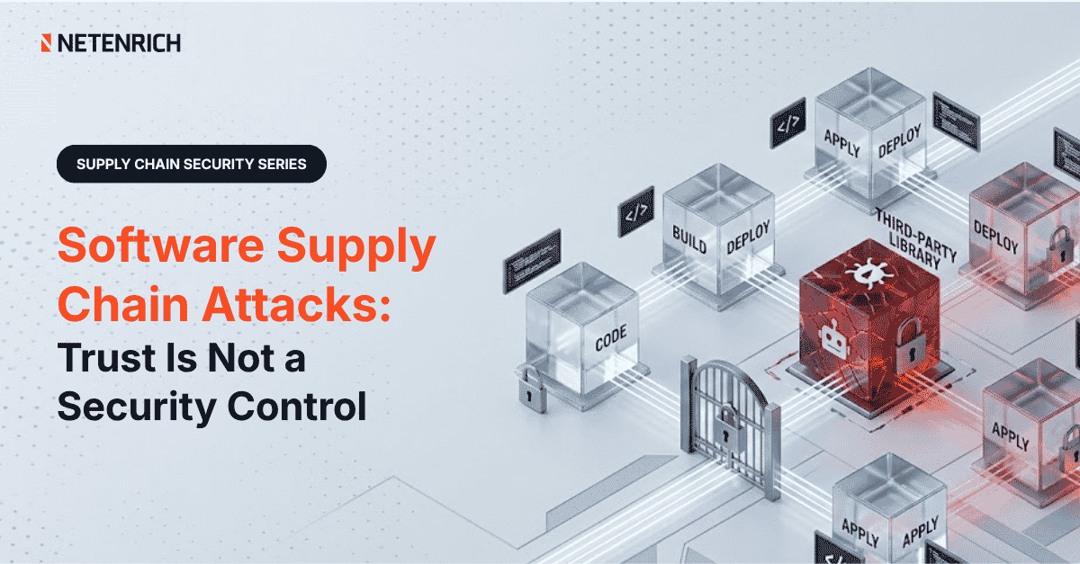
Most enterprise applications today are more integration projects than original code. Open-source libraries, third-party APIs, automated pipelines, vendor-managed cloud infrastructure; none of it is written by the teams responsible for securing it. And most of it carries a silent assumption baked into how modern development works: if it came from a trusted source, it's safe.
That assumption is what attackers have spent the last decade learning to exploit. Supply chain attacks don't need to defeat your perimeter controls. The payload doesn't need to sneak in. It gets delivered through the same channel your organization uses to receive legitimate software; signed, verified, and welcomed in.
Traditional security investment is built around the idea of keeping attackers out. Supply chain attacks invert that entirely.
The defining characteristic of a supply chain attack is that the attacker doesn't target you directly. They target something you trust, say a package you depend on, a vendor with access to your environment, a build tool your team uses every day, and let that trust relationship do the work.
The reach this creates is the point. One compromised package maintainer account. One poisoned update. Tens of thousands of organizations pulling the same malicious artifact through their own automated systems, on their own scheduled jobs, without a single anomaly flag. The security tools see a legitimate package from a known source. They were never designed to question it.
What makes this especially difficult operationally is the delay. The delivery looks clean. The installation looks clean. The compromise may sit dormant for weeks before it activates, by which point the attacker has had time to map the environment, establish persistence, and identify what's worth taking.
Three characteristics make supply chain attacks particularly dangerous:
Scale. One upstream compromise, thousands of downstream victims. The economics of the attack are fundamentally different from targeted intrusions.
Legitimacy. Malicious payloads travel inside trusted artifacts such as signed binaries, verified package releases, approved vendor updates. Endpoint and perimeter controls treat them as clean.
Dwell time. Because the initial delivery mechanism appears legitimate, supply chain compromises are frequently undetected for weeks or months. The attacker has time to establish persistence, conduct reconnaissance, and move laterally long before anyone realizes something is wrong.
Supply chain attacks aren't improvised. They follow a deliberate progression, and understanding that sequence matters for knowing where detection is actually possible.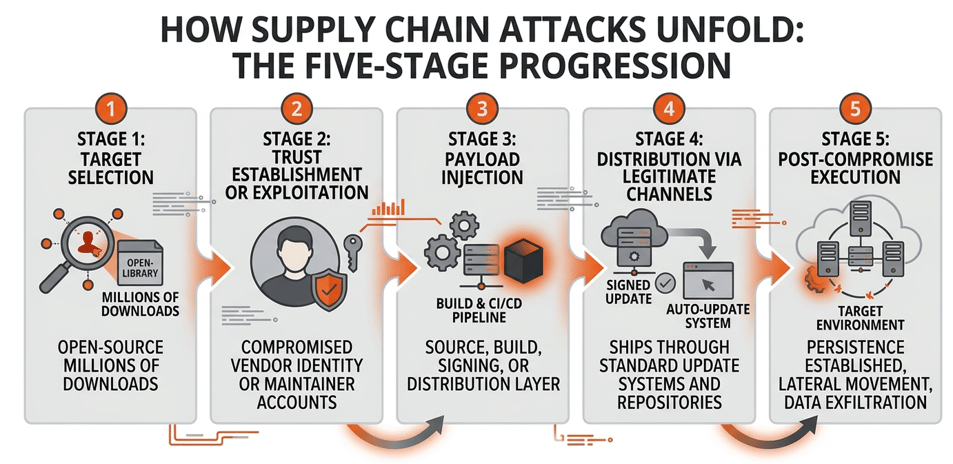
It starts with target selection, not of the victim organization but of the upstream component that gives the attacker the widest reach. A well-maintained open-source library with millions of weekly downloads. A CI/CD tool embedded in enterprise development workflows. An MSP with privileged access to hundreds of customer environments. The attacker picks the lever, not the target.
From there, access to that component is either compromised or gradually established; a stolen maintainer credential, a long-running open-source contribution campaign, a phishing attack on a build server. Once in, the payload goes in: into the source, into the build output, into the signed release. It travels downstream through the same distribution channels that carry every legitimate update. Package managers pull it. Auto-update systems install it. And once it's running inside target environments, the actual attack begins: credential harvesting, lateral movement, data staging, exfiltration.
The window for detection is narrow at every stage. Most organizations only have a realistic chance at the last one.
Supply chain threats span the entire software development lifecycle. The table below maps all eight vectors, what they target and why each one evades conventional detection. Each vector will be covered in depth in its own installment of this series.
| # | Attack Vector | Primary Target | Why It Bypasses Traditional Controls |
|---|---|---|---|
| 1 | Open-Source Dependencies | Package registries, maintainer accounts | Arrives via the same package manager and account that legitimate updates use — often indistinguishable from a routine version bump. |
| 2 | Build & CI/CD Pipelines | Pipeline secrets, runner hosts | Source code looks clean, the compromise happens after it leaves the repository and before it becomes a deployable artifact. |
| 3 | Source Code & Software Production | Developer environments, signing infrastructure | Malicious code ships inside the vendor's own signed release, every downstream check validates a compromised artifact. |
| 4 | Third-Party Vendors & Identity | MSP/SaaS privileged access | Access is legitimate by design, attackers inherit provisioned permissions with no additional foothold required. |
| 5 | Distribution & Update Infrastructure | Update servers, CDNs, auto-update | Software arrives through the same channel as legitimate updates, auto-update mechanisms install it silently and automatically. |
| 6 | Hardware & Firmware | BIOS/UEFI, embedded components | Operates below the OS; survives reimaging; invisible to software-based controls and endpoint detection. |
| 7 | Cloud & Infrastructure-as-Code | Container images, Terraform, Helm | IaC artifacts carry implicit trust, most organizations scan application code but treat public registry images and modules as safe. |
| 8 | AI/ML Supply Chain | Models, datasets, ML pipelines | Backdoored models pass standard benchmarks; poisoned behavior activates only under specific conditions that tests don't cover. |
The common thread across all eight vectors is that conventional perimeter and endpoint controls were not designed to catch them. Attacks that arrive through trusted channels, inside signed artifacts, via legitimate credentials, require a different detection model.
Effective supply chain defense requires three capabilities working together.
Continuous visibility across trust relationships. You cannot defend what you cannot see. That means maintaining a live inventory of every external dependency, vendor integration, pipeline credential, and infrastructure artifact; not a point-in-time audit, but a continuously updated map of what your environment actually trusts and why.
Behavioral detection at the execution layer. Signature-based controls validate what something claims to be. Behavioral detection monitors what it actually does. A compromised package that installs cleanly but then queries cloud metadata endpoints, modifies system files, or establishes unexpected outbound connections will be invisible to integrity checks and visible to behavioral analytics.
Identity-aware correlation across the development and production stack. Supply chain attacks move through the same pipelines and accounts that legitimate operations use. Detecting them requires understanding the behavioral baseline of every identity in the chain (human developers, service accounts, pipeline runners, vendor integrations) and surfacing deviations that individual tools, operating in isolation, cannot connect.
Software supply chains are not going to get simpler. The dependencies, the automation, the vendor relationships, the AI integrations; all of it will continue to grow in complexity and scope. Attackers understand this, and they are investing accordingly.
The organizations best positioned to defend against supply chain attacks are not necessarily those with the most security tools. They are those with the clearest picture of what their environment trusts, the most rigorous governance over those trust relationships, and the detection capabilities to recognize when something trusted is behaving in ways it should not.
Trust is an operational necessity. It is not, by itself, a security control.
Open-Source Dependencies: How attackers compromise package registries and maintainer accounts to deliver malicious code through the same package manager your build system already trusts, often indistinguishable from a routine version bump.
Understanding the supply chain attack surface is the first step. Knowing whether your current detection and response capabilities can identify a compromise at each of these eight vectors (before it reaches production) is a different question entirely.
The best source of information for Agentic SOC and Cyber Risk Operations best practices. Join us.