

AI Threat Hunting: Uncovering the Unknown Unknowns
.webp?width=30&name=Raju%20(1).webp) Raju Chekuri: 06/10/2026
Raju Chekuri: 06/10/2026
Digital Pulse: A Book by our CEO

Platform
Featured Videos

Digital Pulse: A Book by our CEO
Digital Pulse: A Book by our CEO
Published on July 9, 2026 | Last updated on July 9, 2026 | 2 min read
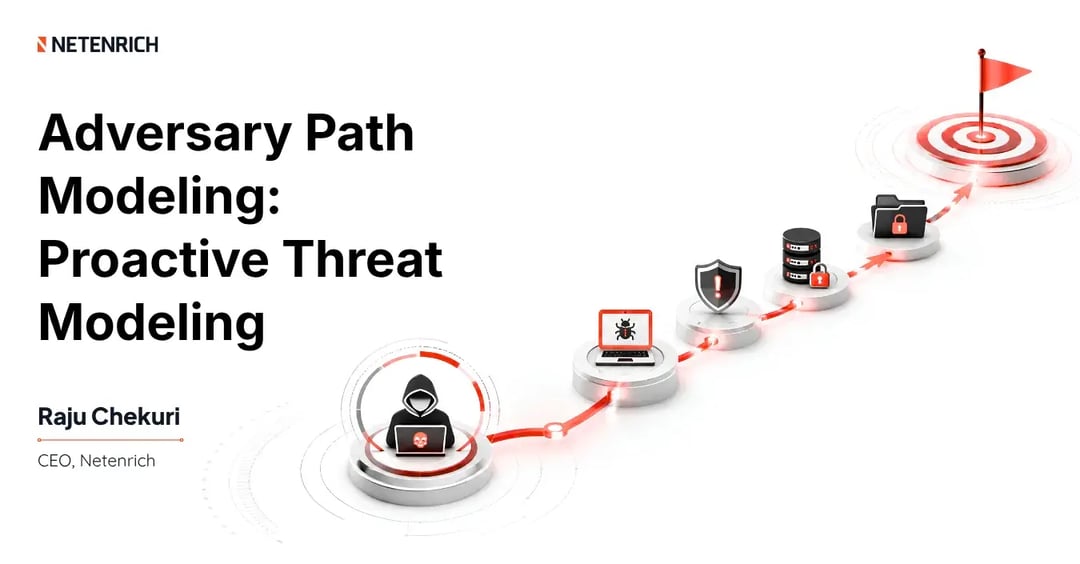
Lateral movement is one of the most important adversary techniques to detect - and one of the hardest. Here is why.
Adversaries who have achieved initial access extend their reach through the access relationships that already exist in the target environment. They move from a compromised account to systems that account can access. From those systems they harvest new credentials. With those credentials they access new systems. Each hop follows the access topology of the environment. The adversary is not creating new paths - they are traversing paths that already exist because legitimate operations require them.
This means that the lateral movement roadmap of every adversary who targets your organization is already inside your environment - encoded in the access relationships that exist right now. The question is whether you have mapped it before they do. This is where continuous attack path analysis shifts from a theoretical framework to an absolute operational necessity.
Adversary path modeling is the systematic application of graph traversal to this problem. Starting from candidate initial access points - accounts reachable through common attack techniques, internet-facing services with known vulnerability patterns, contractor identities with remote access - the model traverses the access graph to identify which high-value targets are reachable, through which intermediate systems and accounts, within how many hops.
The security value of this analysis is proactive in ways that alert-based detection cannot be. Integrating an elite attack path analysis framework into your security operations architecture delivers three core advantages:
The accounts and assets that, if compromised, provide an adversary with the broadest or most critical access are identifiable from the graph structure alone. Hardening these - revoking unnecessary privilege, enforcing stronger authentication, adding monitoring sensitivity - reduces the blast radius of any future compromise.
A rigorous attack path analysis consistently reveals dangerous access relationships with zero current operational justification. This includes access granted for a completed project and never properly revoked, group memberships inherited from deprecated roles, service account permissions that accumulated through incremental expansion without review. These are unintentional attack paths. Closing them does not require a security incident to justify the work.
The paths from common initial access points to critical targets are the paths an adversary would rationally prioritize. Applying heightened detection sensitivity specifically to activity along these paths creates targeted coverage for the most probable adversary approaches without requiring broad alerting that generates noise.
Tired of traditional SIEM environments missing stealthy lateral transitions across network boundaries? Deploy a Netenrich Agentic SOC in 30 Days to achieve native graph visibility, automate your attack path analysis, and neutralize threats in under 3 minutes.

At Netenrich, our approach to attack path analysis runs continuously against the evolving access topology of every customer environment. New paths that open - because of new asset deployment, access grant changes, or newly discovered trust relationships - surface immediately rather than waiting for the next scheduled assessment.
The adversary is mapping your environment. The question is whether you are mapping it first.
*Part of my ongoing series on data science and the future of security operations.*
The best source of information for Agentic SOC and Cyber Risk Operations best practices. Join us.


.png?width=337&height=172&name=Why%20wrong%20layer%20correlation%20drives%20(1).png)