








Move Beyond Alert-Driven Security Operations.
Human-Speed Security Operations Can’t Keep Up.
Modern attacks operate at machine speed, while most SOCs still depend on human-speed triage, fragmented tooling, and reactive workflows.
Netenrich helps enterprises evolve from alert-centric operations to continuous Cyber Risk Operations — combining AI agents, behavioral analytics, and operational risk reasoning to reduce noise, uncover hidden threats, and continuously align threats, controls, and attack surface.
Powered by Google SecOps. Operationalized by Netenrich.
THE DISCIPLINE
"Cyber Risk Operations is the continuous, automated discipline of identifying, structuring, reasoning over, and reducing risk across an enterprise’s digital estate — operating at the speed and scale of AI-augmented threats, with full auditability of every risk decision made."
What it is
- A continuous operating discipline — not a periodic assessment
- Decision-level intelligence with full audit trails
- An OS layer that compounds in value over time
- Risk quantification tied to your live environment
- Architected for machine-speed threat environments
What it is not
- Security monitoring or alert management
- Data plumbing or SIEM infrastructure
- Posture scoring from a questionnaire
- A managed service defined by analyst headcount
- Another platform between you and your data
WHY ADJACENT CATEGORIES FALL SHORT
Each solves part of the problem. None address the discipline.
MDR / MSSP
Labor arbitrage ≠ operating discipline
XDR / SIEM Platforms
Infrastructure ≠ operations
CNAPP / Posture Tools
Snapshot ≠ continuous
CTEM / RBVM
Identification ≠ operations
GRC / Risk Quantification
Annual frameworks ≠ live operations
MDR / MSSP
Labor arbitrage ≠ operating discipline
Human-scale by design. Unit economics require headcount to grow with threat volume. Black-box outputs can’t satisfy transparency demands. Cannot automate without destroying the business model.
XDR / SIEM Platforms
Infrastructure ≠ operations
Detection and data infrastructure — no ontology layer, no reasoning engine, no continuous risk quantification. Buyers still need to operationalize on top. That gap is exactly what Cyber Risk Operations fills.
CNAPP / Posture Tools
Snapshot ≠ continuous
Point-in-time configuration assessment. No threat reasoning, no live risk scoring. Risk is measured in surveys — not system telemetry. Stale the moment it’s published.
CTEM / RBVM
Identification ≠ operations
Continuous Threat Exposure Management identifies and prioritizes exposure. Cyber Risk Operations goes further — A.C.T. structures the environment, L.I.C. reasons over it, agents act on it. CTEM is an input here, not a substitute.
GRC / Risk Quantification
Annual frameworks ≠ live operations
Survey-based, annual cycle, disconnected from operational telemetry. Risk scores not derived from live environment data. Cannot respond to real-time adversary behavior.
THE RESOLUTION INTELLIGENCE CLOUD™
An Operating system, not a platform.
A platform is something you build on. An Operating System is something you run on — it accumulates ontology, develops network effects, and becomes more valuable with every deployment. The Resolution Intelligence Cloud™ is that Operating System.
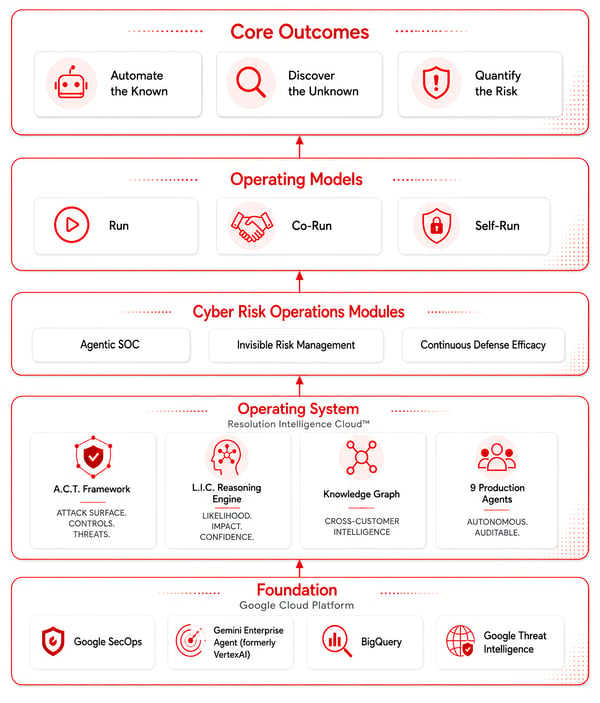
FOUR PILLARS OF CYBER RISK OPERATIONS
The architecture that makes the discipline defensible.
Pillar 01
A. C. T
A.C.T. Framework
ATTACK SURFACE · CONTROLS · THREATS
Your CMDB tells you what you owned last quarter. A.C.T. tells you what exists right now — cloud instances, containers, shadow assets, and the controls actually functioning on each one. The three dimensions work at their intersection: a critical asset with a failed control under active threat isn’t a medium-severity alert. It’s your highest-priority risk. A.C.T. sees the difference automatically.
What it gives you:
A living model of your environment — not last quarter’s asset scan. The difference between knowing rain is coming and knowing your roof has a hole.
Pillar 02
L.I.C
L.I.C. Reasoning Engine
LIKELIHOOD · IMPACT · CONFIDENCE
Legacy security reports on activity — events blocked, tickets closed, alerts triaged. L.I.C. reports on outcomes. Likelihood is calculated from threat capability and control effectiveness. Impact is derived from the business value of the specific asset at risk. Confidence reflects data fidelity. Together they produce a risk score in dollars of financial exposure — the language the board actually speaks.
What it gives you:
When the board asks “Are we secure?” — you answer with a number, not a narrative.
Pillar 03
CROSS-CUSTOMER KNOWLEDGE
Cross-Customer Knowledge Graph
COLLECTIVE INTELLIGENCE · NETWORK EFFECT
Every deployment enriches a shared, anonymized intelligence layer. Attack patterns seen in one environment sharpen detection across all others — automatically, without configuration. The system applies radical relevance filtering: a Linux ransomware campaign is noise for a Windows-only shop. A supply chain attack targeting healthcare software is irrelevant to financial services. The graph knows your stack and filters accordingly.
What it gives you:
Detection accuracy that compounds with every deployment — a network effect human-scale operations structurally cannot replicate.
Pillar 04
AI AGENTS
NINE AI AGENTS IN PRODUCTION
AUTONOMOUS · AUDITABLE · ALWAYS-ON
Not AI bolted onto broken architecture. Not a chatbot suggesting next steps. Purpose-built agents that maintain state, execute multi-step workflows, and make decisions autonomously — handling approximately 98% of alert processing so your analysts focus on the 2% that requires human judgment, creativity, and adversarial thinking. Data validation, correlation, investigation, behavioral analytics, threat hunting. Continuously. With full audit trails on every decision.
What it gives you:
The 98/2 principle — machines handle the noise, humans handle the strategy. Operations that scale with threat volume, not headcount.
A DIGITAL WORKFORCE OF AI AGENTS
AI Agents Built for Continuous Cyber Risk Operations
Instead of relying exclusively on manual investigation workflows, Netenrich deploys a coordinated system of AI agents that continuously monitor, reason, investigate, validate, and respond across the environment.
These agents operate with full auditability and human oversight.
Visibility & Validation
Data Validation Agents
Continuously validate telemetry integrity, parser health, ingestion quality, and silent logging failures.
Posture & Control Analytics
Identify configuration drift, failed controls, and operational gaps before attackers exploit them.
Threat Detection & Analytics
Behavioral Analytics Agents
Establish operational baselines for users, assets, identities, and workloads to identify anomalous activity and hidden threats.
Signal Analytics Agents
Analyze historical and real-time telemetry to identify attack patterns and slow-moving adversarial activity.
Threat Modeling Agents
Continuously evaluate detection coverage and operational readiness against evolving attacker behaviors.
Investigation & Correlation
Correlation Agents
Connect signals into contextual incidents aligned to attack surface, controls, exposure, and operational risk.
Investigation Agents
Automate investigations, map attacker behavior, and accelerate operational decision-making.
Autonomous Response
Response & Remediation Agents
Execute containment, enrichment, and remediation workflows at machine speed, overseen by humans-in-the-loop.
Threat Hunt Agents
Continuously hunt for unknown or emerging threats across historical and live operational data.
Machines Handle the Operational Noise.
Netenrich customers typically experience up to a 98% reduction in manual operational workload, allowing analysts to focus on investigation, strategy, and higher-order security decisions rather than repetitive alert triage.
98%
Workload Reduction
ONE OPERATING SYSTEM
Three modules.
Three ways to run each one.
Choose the modules that match your security maturity. Then choose how you want to operate them - Netenrich runs it for you, you run it with us, or your team runs it independently.
Module 01
AGENTIC SOC
An autonomous, software-driven architecture embedded natively in your environment. Replaces legacy, reactive alert triage with machine-speed detection, investigation, and containment.
CORE CAPABILITIES
- Hyper-autonomous AI agents — Data Validation, Threat Modeling, Correlation, Deep Forensic Investigation
- Petabyte-scale ingestion & normalization across endpoint, identity, cloud, and network layers
- Multi-signal correlation grouping cross-layer anomalies into unified, context-rich Situations
- L.I.C. quantitative risk scoring fusing MITRE ATT&CK stages and FAIR frameworks
- Automated response playbooks via Google SecOps SOAR
- Detection & hunt toolkits
Engagement Models
Netenrich manages all detection, triage, investigation, and containment end-to-end. You receive outcomes and board-ready risk reporting — not alert queues.
Best for: Lean teams and mid-market enterprises
CO-RUN
We operate, you steer
Full transparency into every agent decision and L.I.C. risk score. Your team tunes detection logic and audits any workflow. Netenrich runs the system — you direct it.
Best for: Google SecOps buyers who won’t accept a black box
SELF-RUN
Your team operates it
Agentic SOC capabilities licensed as an OS your engineers build on. Forward-deployed Netenrich engineers embedded at stand-up to accelerate and support.
Best for: Detection engineering teams with existing operational depth
Request a free trialModule 02
INVISIBLE RISK MANAGEMENT
Migrates defenses from static configurations to live behavior analytics — exposing where operational lines systematically break down before adversaries find them first.
CORE CAPABILITIES
- Standing Posture across 5 Lenses: Identity, Data, Workforce, Exposure, Production
- Posture & control intelligence — surfaces privilege drift, silent failures, unencrypted repositories
- 20+ extensible behavioral models tracking count, volume, and structural anomalies
- Cross-model anomaly sequencing into cohesive kill-chain narratives with AI-generated timelines
- Monthly posture-driven threat hunting scoped to your real-world risk gaps
- Continuous risk register with live-telemetry escalation guardrails
Engagement Models
Netenrich continuously monitors posture across all five lenses, runs monthly threat hunts, and maintains the risk register. You receive prioritized risk intelligence — not raw findings.
Best for: Security leaders who need risk visibility without operational overhead
CO-RUN
We operate, you steer
Your team gains full access to behavioral model outputs, posture lens data, and risk register logic. Netenrich operates the analytics layer — your team directs hunt priorities and risk thresholds.
Best for: Teams with security analysts who want to engage with risk data directly
SELF-RUN
Your team operates it
Behavioral models, posture lenses, and risk register as licensed primitives your engineers configure and extend. Netenrich engineers available for model calibration and methodology support.
Best for: Mature security engineering teams building custom risk operations
Book a DemoModule 03
CONTINUOUS DEFENSIVE EFFICACY
The apex configuration. Operationalizes the full A.C.T. framework to continually manage true risk and deliver provable readiness metrics — in the language boards and regulators require.
CORE CAPABILITIES
- Executive A.C.T. posture dashboard — provable defensive readiness across all ecosystems
- Attack surface engineering — Digital Twin mapping Crown Jewels by business unit
- Continuous control validation — closes the Detection-to-Prevention Gap
- Threat-to-control correlation — adversary tactics mapped against your active controls
- Business-aligned risk register — exposure gaps quantified as financial impact
- Automated board scorecards — technical logs transformed into ROI-ready financial metrics
Engagement Models
Netenrich manages the full A.C.T. framework — maintaining the Digital Twin, validating controls continuously, and delivering automated board scorecards on your cadence.
Best for: CISOs who need board-ready risk output without building the capability in-house
CO-RUN
We operate, you steer
Your team participates in A.C.T. configuration, Crown Jewel classification, and board scorecard review. Netenrich operates the system — your team validates and contextualizes.
Best for: Teams who want to own the narrative around board reporting
SELF-RUN
Your team operates it
The full A.C.T. framework, control validation engine, and risk register as a licensed system your engineers operate. Forward-deployed Netenrich expertise for strategic methodology guidance.
Best for: Large enterprises with dedicated risk engineering and governance teams
Book a Demo|
SUMMARY MATRIX
How it all fits together
|
|||
| Module |
RUN
Netenrich operates fully
|
CO-RUN
Netenrich operates, you steer
|
SELF-RUN
Your team operates
|
|---|---|---|---|
| 01 Agentic SOC |
✓ Full autonomous operations | ✓ Transparent, steerable operations | ✓ Licensed OS + engineering support |
| 02 Invisible Risk Management |
✓ Managed posture & hunting | ✓ Direct access to risk data | ✓ Licensed behavioral models |
| 03 Continuous Defensive Efficacy |
✓ Managed A.C.T. + board scorecards | ✓ Co-owned governance & reporting | ✓ Licensed A.C.T. system |
| Modules can be deployed individually or in combination. All modules are available in all three operating models. Talk to Netenrich to find the right configuration for your team. | |||
Measurable Operational Outcomes
Cyber Risk Operations is designed to improve operational readiness, visibility, and security effectiveness continuously over time.
Netenrich customers typically experience:
METRICS REPORT
Improvement in Detection Coverage
Cyber Risk Operations continuously reasons across broader telemetry, behavioral analytics, attack surface exposure, and operational context; uncovering blind spots, drift, and attacker activity traditional operations often miss.
METRICS REPORT
Reduction in Manual Operational Workload
AI-driven operational workflows continuously validate, correlate, investigate, and prioritize activity — allowing analysts to focus on strategic investigation and higher-order security decisions instead of repetitive triage.
METRICS REPORT
Reduction in Exposure Pathways
Continuous alignment across attack surface, controls, posture, and threats helps eliminate hidden operational gaps adversaries commonly exploit.
METRICS REPORT
Improvement in Control Health
Continuous validation across telemetry pipelines, detections, configurations, and security controls reduces silent failures, operational drift, and control degradation.
METRICS REPORT
Proactive Threat Hunts Per Month
Behavioral analytics and continuous operational reasoning proactively identify hidden attacker behavior, anomalous activity, and emerging operational risk before escalation.
METRICS REPORT
Security Efficacy Improves Quarter Over Quarter
Cyber Risk Operations continuously adapts as environments, attack surfaces, and adversary behaviors evolve — improving operational readiness, visibility, and risk alignment over time.
CUSTOMER EVIDENCE
Delivering Real-World Outcomes Across Enterprise Security Operations
Global Data Security Leader
Global Digital Transformation Enterprise
Global Software & Cloud Infrastructure Company
Global Technology Enterprise
Global Data Security & Cyber Resilience Leader
Challenge:
Following a large acquisition, the customer needed to consolidate security operations across rapidly growing environments while managing escalating SIEM costs, alert fatigue, and increasing operational complexity.
Outcomes:
- Significant reduction in alert noise and operational fatigue
- Faster, more contextual threat investigation workflows
- Improved control over security data ingestion costs
- Successful migration from legacy SIEM and MSSP tooling
Global Digital Transformation Enterprise
Challenge:
A global enterprise modernized security operations across large-scale environments by reducing alert overload, improving operational visibility, and automating investigation and response workflows through Agentic SOC.
Outcomes:
- Improved SOC visibility across cloud-scale environments
- Reduced alert fatigue through contextual detections
- Faster incident response with automated workflows
- Shift from reactive monitoring to proactive threat operations
Global Software & Cloud Infrastructure Company
Challenge:
A large enterprise organization modernized legacy SIEM and SOAR operations into a unified Google SecOps and Netenrich operating model with greater operational transparency and continuous risk visibility.
Outcomes:
- Significant operational cost reduction
- Expanded detection coverage
- Faster investigation and escalation workflows
- Improved operational visibility and confidence
Global Technology Enterprise
Challenge:
A security engineering organization operationalized Google SecOps using Netenrich Cyber Risk Operations Studio to improve detection engineering, operational consistency, and threat visibility across complex enterprise environments.
Outcomes:
- Accelerated operational maturity
- Improved engineering efficiency
- Greater visibility into attack surface and control effectiveness
- Enhanced operational scalability and consistency
ECOSYSTEM & INTEGRATIONS
Built on Google SecOps. Works with the stack you have.
Google SecOps is the substrate. Chronicle · SOAR · Google Threat Intelligence · BigQuery. This is an architectural dependency — not a reseller arrangement. The Resolution Intelligence Cloud™ is the operations layer that turns Google’s infrastructure into outcomes.
Google Cloud Partner
Named Google Partner of the Year:
Security – North America MSSP
200+
Feed and Log Sources
25+
Enabled Integrations
7
Integration Categories
All
CMDB
Security
Cloud
Posture
ITSM
Monitoring
Log Ingestion 200+
ServiceNow
Google SecOps
Chronicle
Cloudflare
Google Threat Intelligence
Abnormal Security
Trend Micro
1Password
1Password Audit Events
FM Systems Workplace Mgmt
Trend Micro Server Protect
1KOSMOS | Identity & Auth
3Com 8800 Series Switch
A10 Load Balancer
Absolute MDM
Absolute Secure Endpoint
Acalvio
Accellion
Accenture Synthetic
Accops Hysecure VPN
Acquia Cloud Platform
Acronis Backup
Action1
Active Countermeasures
Active Identity HID
Adaptive Shield
AWS
Azure
Google Cloud
Wiz
Orca Security
Jira
GitHub
Prometheus
CloudWatch
Azure Monitor
Google Cloud Monitoring
GCP Monitoring
OpsRamp
LogicMonitor
Site24×7
ConnectWise
FAQs
Questions we hear in every first call.
-
How is Cyber Risk Operations different from MDR or MSSP?
MDR and MSSP are built on analyst headcount — their unit economics require headcount to grow as threat volume grows. Cyber Risk Operations scales with agents, not people. The outcome isn’t faster human response. It’s a fundamentally different operating model that doesn’t hit the same capacity ceiling.
-
How is this different from CTEM or Risk-Based Vulnerability Management?
CTEM and RBVM identify and prioritize exposure. Cyber Risk Operations goes further — A.C.T. structures the environment, L.I.C. reasons over it, agents act on it, and the knowledge graph compounds the intelligence. CTEM is an input here, not a substitute.
-
Do I have to replace my existing tools or SIEM?
No. The Resolution Intelligence Cloud™ operationalizes what you already have — it doesn’t replace it. For organizations on Google SecOps, there’s no platform migration required. Full capability depth requires Google SecOps as the primary substrate.
-
Can I start with one operating mode and move to another?
Yes. The operating modes are expressions of the same OS — not separate products. Organizations move toward greater internal ownership as their capabilities mature. Netenrich has structured migration pathways between all three modes.
-
How does L.I.C. scoring satisfy external auditors and GRC frameworks?
Every L.I.C. decision includes Likelihood, Impact, and Confidence with supporting evidence — auditable line by line. Outputs map directly to NIST CSF, ISO 27001, SOC 2, SEC cybersecurity disclosure rules, and NIS2.
-
How does the Cross-Customer Knowledge Graph protect data privacy?
The graph operates on anonymized, aggregated behavioral patterns — not raw logs or customer-identifiable content. No customer’s data is accessible to any other customer. The architecture satisfies enterprise data governance requirements.
Find your operating model.
Whether you want Netenrich to fully operate your security operations, collaborate with your internal SOC team, or provide the operational intelligence layer your engineers build on — we’ll help identify the right approach for your environment.