.png?width=337&height=172&name=Why%20wrong%20layer%20correlation%20drives%20(1).png)
Security Event Correlation: Why Wrong-Layer Rules Drive Alert Fatigue
.webp?width=30&name=Raju%20(1).webp) Raju Chekuri: 29/09/2026
Raju Chekuri: 29/09/2026
Digital Pulse: A Book by our CEO

Platform
Featured Videos

Digital Pulse: A Book by our CEO
Digital Pulse: A Book by our CEO
Published on August 18, 2026 | Last updated on August 18, 2026 | 2 min read
When people ask me what makes the Resolution Intelligence Cloud different from other security intelligence platforms, I usually start with the data architecture. The unified data model, the ontology engine, the knowledge graph, the behavioral analytics. These are real differentiators and they are worth explaining.
But the more fundamental answer is the team that built it.
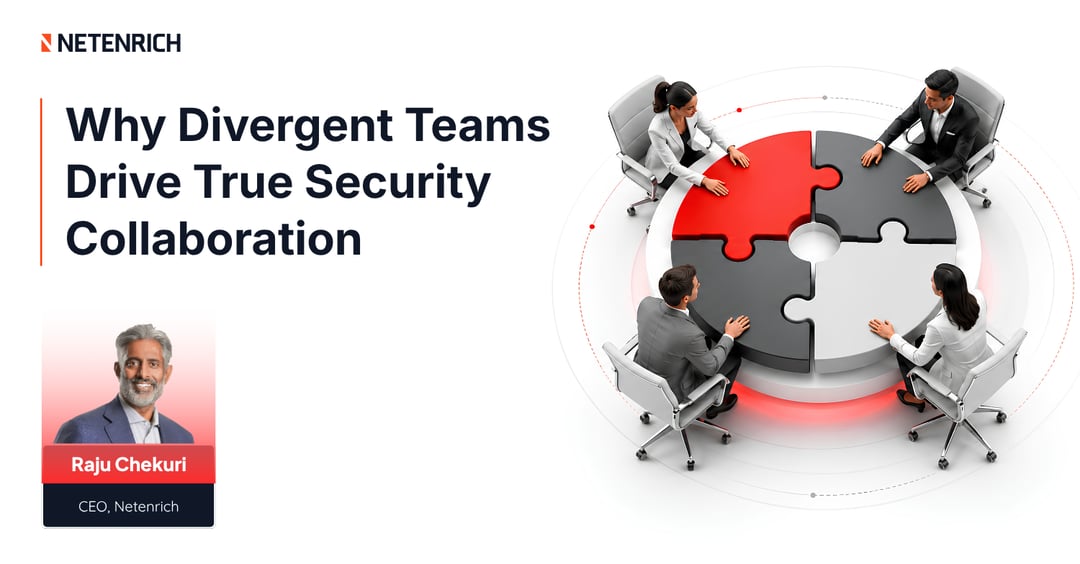
Security companies are typically built by security people. This makes sense — security is a domain-specific discipline and domain expertise matters. The limitation is that security, applied to modern enterprise environments at the data scale that genuine intelligence requires, is not only a security problem. It is simultaneously a data engineering problem, a machine learning problem, an NLP problem, a graph analytics problem, and a distributed systems problem.
| Organizational Dimension | Traditional Security-Only Teams | Divergent Security Collaboration Teams |
| Problem Approach | Focuses strictly on rule-based signatures and manual alert triage. | Formalizes security challenges as statistical optimization and graph problems. |
| Data Architecture | Relies on third-party SIEM parsers and static log dumps. | Engineers custom ingestion pipelines and real-time canonical schemas. |
| Model Reliability | Ad-hoc scripts that generate high false-positive noise. | Production-grade ML models calibrated for high precision and analyst trust. |
| Cross-Functional Velocity | Hand-off friction between threat analysts and IT teams. | Earned fluency spanning data science, threat hunting, and distributed systems. |
Building the RIC required people who could solve all of these simultaneously and, more importantly, who could work together across discipline boundaries well enough to build something coherent.
Security Practitioners: Brought genuine understanding of how adversaries operate, intuition for which behavioral patterns are analytically meaningful, and experience with how SOCs operate under pressure. They ensure data science solutions solve real operational problems rather than elegant theoretical ones.
Data Scientists & ML Engineers: Brought the ability to formalize security challenges into statistical models, familiarity with behavioral analytics, and the engineering discipline to build reliable algorithms for autonomous AI agents in production.
Data Engineers: Built the ingestion pipelines, normalization architecture, and query infrastructure that make sub-second analytics possible across multi-cloud enterprise data lakes.
What has developed over six years of working together is something I find genuinely rare in technology organizations: cross-disciplinary fluency. Our security practitioners can have substantive technical conversations with our ML engineers about precision-recall tradeoffs and why they matter for analyst trust. Our data scientists can talk about the adversary's kill chain progression and why it matters for sequence model design. The fluency is earned through years of working on the same problem from different angles.
This team was assembled around a cause: build the data foundation for genuine security intelligence, apply the full data science toolkit to it, and create something that gets smarter every day. That cause is what brought them together. The shared work is what made them exceptional.
RReady to move past isolated vendor tools and empower your team with true security collaboration? The Netenrich Agentic SOC represents six years of cross-disciplinary engineering, packaging production-grade machine learning and elite threat intelligence directly into your daily workflow.

*Part of my ongoing series on data science and the future of security operations.*
The best source of information for Agentic SOC and Cyber Risk Operations best practices. Join us.

.png?width=337&height=172&name=Security%20data%20pipeline%20OG%20Image%20(3).png)
.jpeg?width=337&height=172&name=Image%20(3).jpeg)