.webp?width=30&name=Raju%20(1).webp) Raju Chekuri
Raju Chekuri
.png?width=337&height=172&name=php2shell%20(CVE-2026-109618%20%26%20CVE-2026-109619).png)
php2shell leaked before the patch. Here’s how to close the gap.
 Netenrich: 22/10/2026
Digital Pulse: A Book by our CEO

Platform
Featured Videos

Digital Pulse: A Book by our CEO
Digital Pulse: A Book by our CEO
Published on July 28, 2026 | Last updated on July 28, 2026 | 3 min read
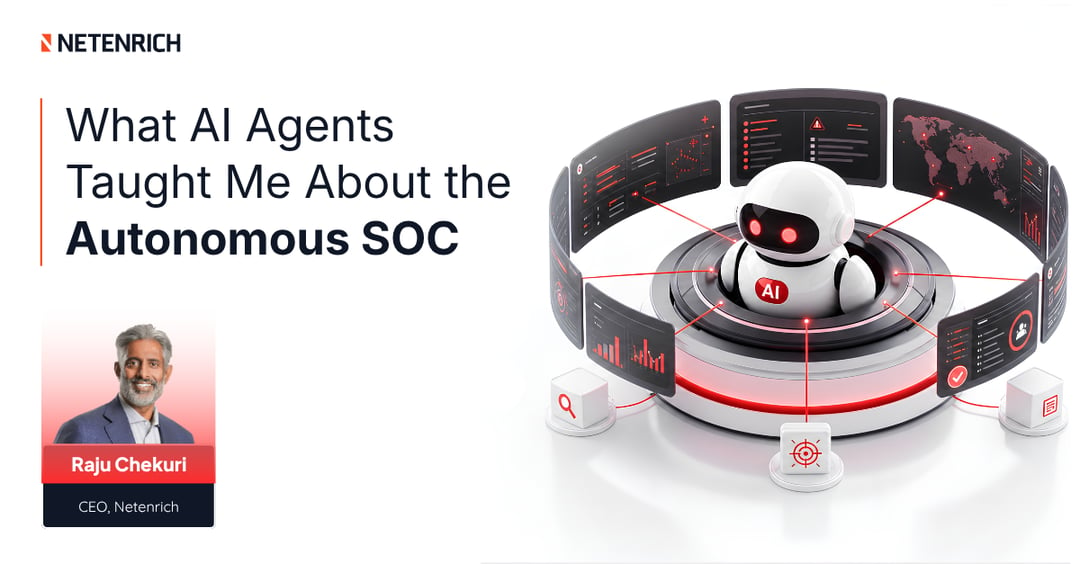
When I talk about agentic AI and the path toward an autonomous SOC at Netenrich, I try to be specific rather than visionary - because the specificity is what is actually useful to the people building or considering these systems.
We run nine production AI agents in the Resolution Intelligence Cloud today. Each was designed around the same set of principles learned through production experience rather than theory: narrow scope, defined inputs and outputs, confidence-gated autonomy, continuous performance monitoring, and explicit human oversight architecture.
Let me share what production taught us, because the lessons are different from what we anticipated.
The first lesson was about scope. Our initial inclination was to build agents with broader scope - the kind of end-to-end coverage often promised by early autonomous SOC concepts, such as,an agent that could handle the full initial investigation workflow for a class of alerts, for example.
Production showed us that broader scope means broader failure modes. When an agent operates across a larger workflow, the cases where it encounters input it was not designed for are more numerous and the consequences of errors are larger.
We systematically narrowed scope. Each agent now does one specific thing:
Each is narrow. Each is reliable. This modular agentic architecture forms the true foundation of a pragmatic autonomous SOC.
The second lesson was about governance architecture. "Human in the loop" is not a sufficient governance description when designing an autonomous SOC.
For each agent, we defined explicitly:
These definitions were initially conservative. They have been calibrated based on observed production performance - expanded where the agent has demonstrated reliability, tightened where we observed systematic errors.
The third lesson was about analyst trust. Agents that analysts trust are agents that analysts understand - what it does, why it produced a specific output, and when to override it. Black-box agents, however accurate, erode trust because they suppress the analyst judgment that is supposed to complement them. Every agent we operate exposes its reasoning. Every output includes the data that drove it. Analysts who disagree can flag the disagreement, and those flags feed our model improvement cycles.
| Operational Vector | Legacy SOAR Playbooks | Agentic Autonomous SOC Framework |
| Workflow Scope | Rigid, multi-step scripts that break on unexpected edge cases. | Narrow, highly specialized AI agents with single-purpose operational roles. |
| Governance & Control | Binary pass/fail execution without confidence thresholds. | Confidence-gated autonomy with explicit human-in-the-loop review triggers. |
| Analyst Trust & Visibility | Black-box automation scripts hiding underlying reasoning. | Fully transparent reasoning chains exposing underlying telemetry and context. |
The cumulative effect of nine narrow, trusted, well-governed agents has been significant. The routine processing that used to consume analyst time - context assembly, intelligence lookup, documentation drafting, is handled reliably. Analyst capacity has shifted toward the investigation, hunting, and judgment work that requires human expertise. The quality of both the automated and human work has improved.
The agentic world is genuinely powerful. It requires the same discipline as every other layer of the data science stack - get the foundation right, govern explicitly, earn autonomy incrementally.
Stop waiting for legacy playbooks to fix your analyst burnout. Deploy a Netenrich Agentic SOC in 30 Days to leverage nine production-ready AI agents, streamline context assembly, and achieve a guaranteed 3-minute threat triage SLA.

*Part of my ongoing series on data science and the future of security operations.*
The best source of information for Agentic SOC and Cyber Risk Operations best practices. Join us.