LIC Scoring: Quantifying Posture & Cybersecurity ROI
.webp?width=30&name=Raju%20(1).webp) Raju Chekuri: 10/09/2026
Raju Chekuri: 10/09/2026
Digital Pulse: A Book by our CEO

Platform
Featured Videos

Digital Pulse: A Book by our CEO
Digital Pulse: A Book by our CEO
Published on December 16, 2025 | Last updated on April 8, 2026 | 3 min read
From the CEO’s Desk
Raju Chekuri, Chairman, President & CEO of Netenrich, shares a candid perspective shaped by conversations with CISOs and CIOs across global enterprises.
I talk to CISOs and CIOs every day, from Fortune 500 boardrooms in New York to hyper-growth tech hubs in Bengaluru. Different markets, different budgets, different scales.
But the look in their eyes is always the same. It is exhaustion.
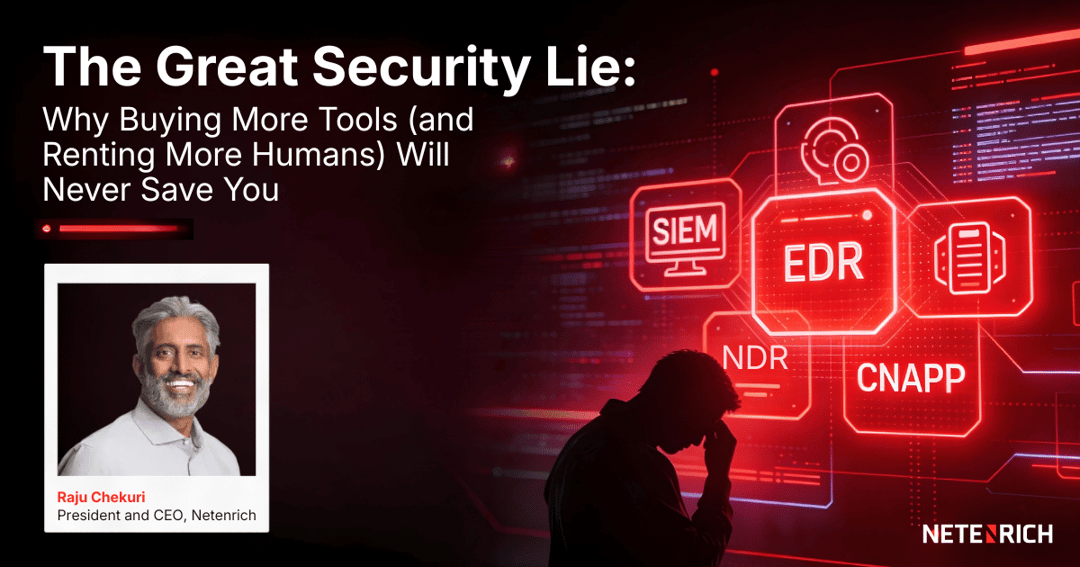
For the last decade, the cybersecurity industry has sold enterprise leaders a lie. The lie is simple: If you just buy one more tool, or hire one more shift of analysts, you will finally be safe. So, we bought the tools. We bought the SIEMs, the EDRs, the NDRs, and the CNAPPs. We hired the armies of Tier 1 analysts or outsourced them to the Big 4. We built massive, complex security stacks that require an army just to maintain.
And yet, the breaches keep happening. The dwell time isn't shrinking. The ransomware payments are getting bigger.
Why? Because we are trying to solve an exponential problem with a linear solution. And until we admit that the math is broken, we will keep losing.

Here is the hard truth no vendor wants to put on a slide: You cannot hire your way out of this. The threat landscape is exponential. Attackers are now leveraging AI and automation to launch campaigns at machine speed. They can move from initial compromise to data exfiltration in less than 60 minutes.
Meanwhile, our defense strategy is linear. We rely on human analysts to stare at screens, triage alerts, and manually investigate tickets. If alert volume goes up by 10x, the industry tells you to hire 10x more people.
That is a losing game. You cannot find enough talent, you cannot train them fast enough, and frankly, you cannot afford them. If you are running a "Body Shop" SOC, whether internal or outsourced, you are fighting a bullet train with a bicycle.
To compensate for this lack of speed, we buy more tools. We layer defense upon defense, creating a "Franken-stack" of 50+ point solutions.
This creates what I call the "Illusion of Coverage."
You look at your dashboard, and it’s all green. You feel safe. But that dashboard is lying to you by omission. It only reports on the assets it knows about. It only shows alerts from the agents that are working.
It doesn't tell you about the shadow IT server marketing spun up last week. It doesn't tell you about the EDR agent that failed silently three weeks ago. It doesn't tell you that your "integrated" platform is actually just three acquired companies duct-taped together via API, and the data isn't actually flowing.
You don't have coverage. You have a false sense of security.
In response to this chaos, many enterprises throw up their hands and outsource the problem. They sign a massive contract with a Big 4 consultancy or a legacy MDR provider, thinking they have transferred the risk.
Let me be clear: You can outsource the labor. You cannot outsource the risk.
When the breach happens, the consultants will point to the "Limitations of Liability" clause in their contract. You will be the one explaining to the Board why you didn't know your own architecture.
Furthermore, most of these legacy providers are incentivized to maintain the status quo. They make money on effort, not efficiency. They bill by the hour or by the ticket. Why would they automate a problem away when they can charge you to fix it manually every single week?
It is time to stop buying "effort" and start buying Outcomes.
If I walked into a board meeting and said, "I bought a hammer," nobody would care. If I said, "I built a house," I’ve created value. Yet, in security, we celebrate buying hammers.
The future of security operations is not about more tools or more people. It is about Autonomous Security Operations.
We need to shift from "Service" (people doing work) to "Engineering" (software doing work).
We are at an inflection point.
You can continue down the path of the "Tool Collector," buying the next shiny widget and hiring the next batch of analysts to watch it.
Or, you can demand Cybersecurity Outcomes as a Software. You can demand a platform that resolves 90% of the noise autonomously, so your humans can focus on the 10% of high-value hunting that actually matters.
The adversaries have already adopted automation. It’s time we did the same.

The best source of information for Agentic SOC and Cyber Risk Operations best practices. Join us.

.png?width=337&height=172&name=Third%20party%20vendors%20OG%20image%20(3).png)