.png?width=337&height=172&name=Why%20wrong%20layer%20correlation%20drives%20(1).png)
Security Event Correlation: Why Wrong-Layer Rules Drive Alert Fatigue
.webp?width=30&name=Raju%20(1).webp) Raju Chekuri: 29/09/2026
Raju Chekuri: 29/09/2026
Digital Pulse: A Book by our CEO

Platform
Featured Videos

Digital Pulse: A Book by our CEO
Digital Pulse: A Book by our CEO
Published on August 20, 2026 | Last updated on August 20, 2026 | 3 min read
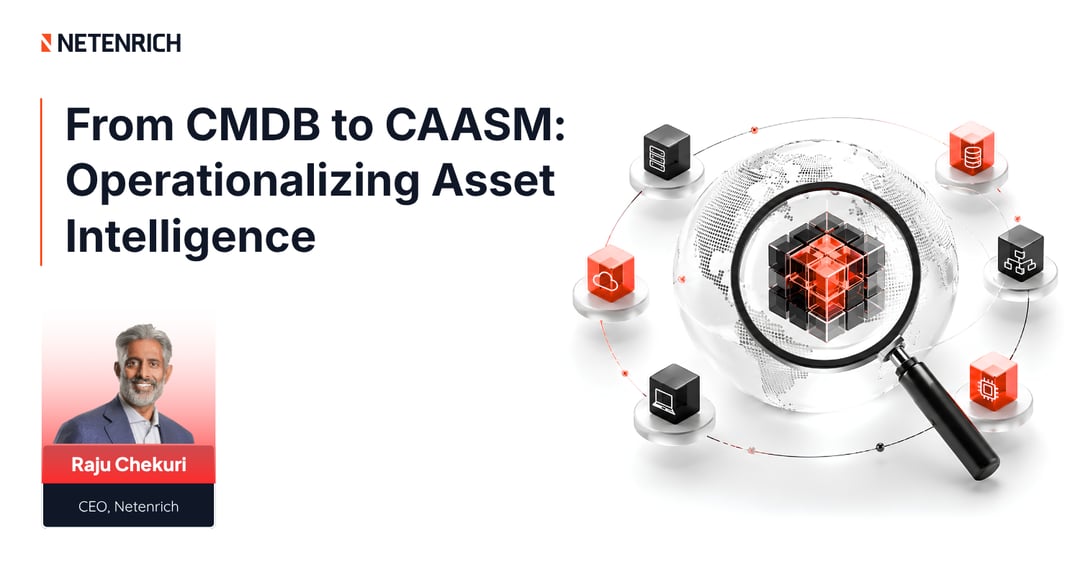
The gap between where most enterprises are on asset intelligence - a CMDB with varying degrees of staleness and completeness - and where the security outcomes they need require them to be is significant.
I want to make the path from here to there concrete, because "operationalize your assets" is easy to say and hard to know how to start.
| Capability Dimension | Traditional CMDB Repositories | Operationalized CAASM Architecture |
| Discovery Mechanism | Manual entries and scheduled vulnerability scans. | Continuous ingestion of telemetry signals, cloud APIs, and network flows. |
| Data Integration | Isolated database queried via external API calls. | Native normalization into a unified security data lake schema. |
| Contextual Depth | Flat inventory lists classified strictly by device type. | Dynamic semantic relationship graphs mapping accounts, services, and workloads. |
| Security Utility | Static compliance checking and asset tracking. | Enables real-time cyber risk quantification and blast radius calculation. |
Operationalizing asset intelligence requires an architectural progression where each layer directly empowers the next:
The fundamental problem with CMDB-based asset management is that it relies on process-driven updates that cannot keep pace with how fast modern environments change. The replacement is discovery driven by the signals the environment itself generates: network flows that reveal communication between assets, authentication events that surface new identities accessing systems, endpoint telemetry that identifies new processes and connections, cloud provider APIs that enumerate running workloads. Discovery from signals is inherently continuous - it reflects the environment as it is right now, not as it was when someone last ran a scanner.
Every discovered asset, entity, and relationship needs to be normalized into the unified data model and integrated as a native participant in the security data platform — not stored in a separate asset management system that the security platform queries through API calls. The distinction matters: a native asset in the data model is available for real-time correlation, enrichment, and analytical workloads at ingestion speed. An API-queried external asset introduces latency and dependency that degrades analytical quality and reliability.
Once assets are in the unified data model, the ontology engine builds and maintains their relationship graph: which accounts have access to which systems, which systems depend on which services, which business processes flow through which digital infrastructure. This relationship context is what transforms a classified asset into a component of the enterprise's digital tone. It is the layer that enables blast radius analysis, adversary path modeling, and impact-based prioritization.
Once assets are continuously discovered, normalized, and relationally enriched, the behavioral analytics layer can establish what normal looks like for each significant asset from its own operational history. Normal network communication patterns. Normal process execution. Normal authentication timing. Deviations from this baseline - particularly when combined with relationship context that shows what the deviating asset is connected to - become high-confidence signals rather than noise.
Each layer makes the next more powerful. Continuous discovery without normalization produces a discovery database. Normalization without ontology produces a catalog. Ontology without baselining produces a static relationship map. All four together produce a living model of the enterprise's digital tone that supports the ACT framework from the ground up.
This is the implementation path we have built into the Resolution Intelligence Cloud. It took years to get right. It is the foundation on which everything else depends.
Tired of stale CMDB spreadsheets and unmonitored attack surfaces? The Netenrich Agentic SOC leverages continuous, telemetry-driven discovery to map your dynamic relationship graph in real time, turning flat asset inventories into actionable threat context. Partner with Netenrich to build a living model of your digital attack surface.

*Part of my ongoing series on data science and the future of security operations.*
The best source of information for Agentic SOC and Cyber Risk Operations best practices. Join us.

.png?width=337&height=172&name=Security%20data%20pipeline%20OG%20Image%20(3).png)
.jpeg?width=337&height=172&name=Image%20(3).jpeg)