Suma Ballal


Intent Based Security: The Cultural Shift in SOCs
.webp?width=30&name=Raju%20(1).webp) Raju Chekuri: 22/10/2026
Raju Chekuri: 22/10/2026
Digital Pulse: A Book by our CEO

Platform
Featured Videos

Digital Pulse: A Book by our CEO
Digital Pulse: A Book by our CEO
Published on June 9, 2026 | Last updated on July 8, 2026 | 5 min read
Non-Human Identities (NHIs)—service accounts, automation tokens, CI/CD pipeline credentials, and cloud IAM roles—now outnumber human users in most enterprise environments by orders of magnitude. They are also among the least protected. Unlike human accounts, NHIs rarely trigger multi-factor authentication, rotate credentials infrequently, and accumulate permissions far beyond their original scope. When a machine identity is compromised, attackers inherit all of it: the access, the trust, and the silence. This fundamental exposure highlights why modern enterprises must prioritize robust non human identity security.
There is a deeper flaw in both approaches: detection rules only fire when logs exist. If an identity is over-privileged, exposed, or misconfigured, log-based rules remain completely silent until after an exploit begins. By the time a rule fires, the attacker may already have what they came for.
Yet most organizations approach NHI security with one of two incomplete strategies: they deploy siloed detection rules that generate a barrage of disjointed alerts lacking business context, or they implement a broad cloud posture platform that lacks the granular inspection logic required to catch deep pipeline or data-tier exploits.
Achieving true resilience against machine-credential attacks requires marrying proactive exposure mapping with reactive runtime precision. That is the structural principle behind the combination of Specialized Detection Content and the Netenrich Adaptive Cloud Detection and Response (CDR) platform; two capabilities that each address what the other cannot.
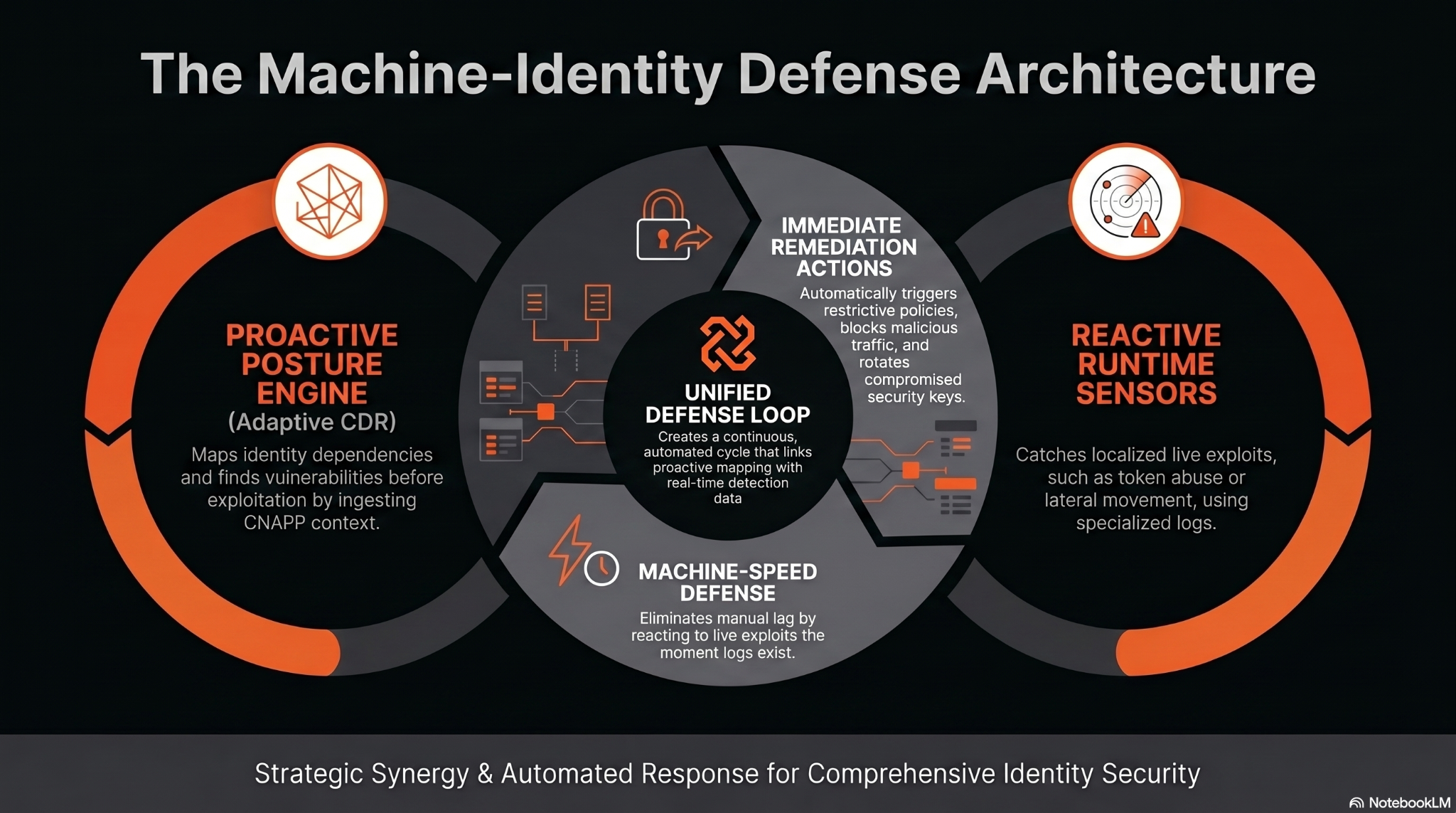
To stop machine-identity attacks, a security platform must understand both what could happen (the proactive posture) and what is happening (the reactive detection). This unified blueprint serves as the foundation for modern cloud identity defense:
| Capability | Proactive Posture (Adaptive CDR) |
Reactive Detection (Specialized Content) |
| Primary Data Source | Dynamic Entity Graphs & CNAPPs (like Wiz) | Live Environment Logs (GitHub, CloudTrail, etc.) |
| Core Focus | Vulnerabilities, blast radius, and toxic permissions | Active exploits, anomalous behaviors, and token abuse |
| Operational Timing | Before an attack occurs | During an active compromise |
Detection content provides the deep technical precision required to spot anomalous activity within highly specific execution layers. However, detection rules are entirely dependent on logs. They act as runtime sensors across your critical environments, triggering only when an adversary actively makes a move:
⚠️ The Standalone Limitation: Deep detection rules are inherently reactive. They cannot tell you if a severe vulnerability exists before it is exploited. Furthermore, they tell your team what happened inside an individual silo, but lack the cross-cloud context to show where the attacker went next.
Powered by the Resolution Intelligence Cloud™, Netenrich Adaptive CDR serves as the centralized operational brain. Instead of waiting around for logs to fire, Adaptive CDR takes a proactive, shift-left approach to find security gaps before they can be weaponized.
Rather than flooding analysts with thousands of uncontextualized events, the platform uses a rigorous LIC Model (Likelihood × Impact × Confidence) to evaluate risks dynamically, ensuring your team fixes critical exposures before they become active breaches.
⚠️ The Standalone Limitation: A posture engine can map exposures perfectly, but without deep, specialized detection rules feeding it high-fidelity runtime signals from the pipeline and data layers, it cannot stop a zero-day exploit or a stolen token bypass in real time.
When you cross-reference proactive posture context with reactive runtime detection, the visibility gap closes entirely. Netenrich pairs what could happen with what is happening to create an end-to-end defense system.
Machine identities are now the primary attack surface in the modern enterprise and they operate in environments where milliseconds matter. Siloed detection rules and standalone posture tools each address half the problem, but neither is sufficient on its own. By coupling Specialized Detection Content with Adaptive CDR, security teams build a complete, closed-loop defense: one that identifies dangerous exposures before attackers arrive and neutralizes active threats the moment they do.
The Netenrich Resolution Intelligence Cloud™ is where proactive posture and reactive detection shake hands—giving security teams the intelligence to defend what has not been exploited yet, combined with the granular, log-based visibility required to crush active attacks the second they begin.
Waiting for a machine identity breach to reveal the blind spots in your non human identity security posture is a risk no enterprise can afford. Start by mapping your non-human attack surface, identifying over-privileged service accounts and pipeline credentials, and validating whether your current detection coverage can catch the specific behaviors attackers rely on. Engage with Netenrich cloud security specialists today to assess your NHI exposure, test your detection efficacy against realistic attack scenarios, and deploy integrated defenses before the next automated attack begins.
Ready to transition from reactive machine monitoring to agentic cloud protection?
Discover how to scale your contextual visibility, map sophisticated non-human identity dependencies, and stop automated credential abuse.

The best source of information for Agentic SOC and Cyber Risk Operations best practices. Join us.