
Probabilistic Security & Attack Path Management
.webp?width=30&name=Raju%20(1).webp) Raju Chekuri: 15/10/2026
Raju Chekuri: 15/10/2026
Digital Pulse: A Book by our CEO

Platform
Featured Videos

Digital Pulse: A Book by our CEO
Digital Pulse: A Book by our CEO
Published on July 23, 2026 | Last updated on July 23, 2026 | 3 min read
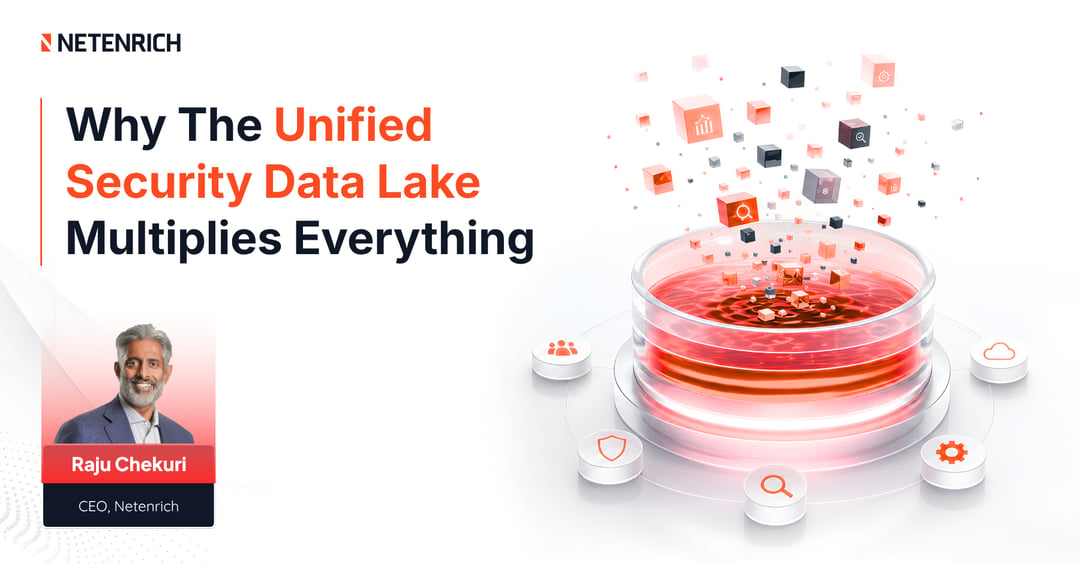
When we built the Resolution Intelligence Cloud, one of the early decisions that shaped everything else was committing to a Unified Data Model - a single, consistent schema to which all telemetry, from every source, is normalized at ingestion.
This decision was not without cost. Building normalization logic for every telemetry source we support - and we support many - required significant engineering investment. Maintaining schema consistency as source systems update their event formats is ongoing operational work. The investment was real.
The return on that investment has compounded into every capability we have built since. It fundamentally changes how an enterprise derives value from a modern security data lake. Let me be specific about why.
Without a unified data model, cross-source analysis requires translation at query time. A detection rule that correlates authentication events from Windows with process execution events from an endpoint agent with network connection events from a network sensor must carry translation logic for each source system's specific field naming conventions and encoding conventions alongside the actual detection logic. This makes rules complex, brittle, and source-specific. When any source system updates its format, the rules that depend on that source may break. This structural fragility is exactly why traditional dump-and-store security data lake architectures fail to scale operationally.
| Architectural Capability | Legacy Dump-and-Store Repositories | UDM-Powered Security Data Lake |
| Ingestion Pipeline | Schema-less raw log dumping (delayed processing). | Immediate normalization to a structured canonical schema at the edge. |
| Detection Rule Resilience | Brittle; rules break when upstream vendors alter field formats. | Decoupled; detection logic remains constant regardless of source updates. |
| ML/LLM Feature Extraction | High resource overhead due to source-specific training variations. | Consistent feature vectors across all environments and telemetry types. |
| Analyst Cross-Querying | Requires manual correlation and multi-schema syntax mapping. | Unified entity resolution across all multi-cloud infrastructure assets. |
With a unified data model, all of these events live in the same schema. "Authentication event" means the same thing whether it came from Windows, Linux, a cloud identity provider, or a SaaS application. "Source IP" is the same field regardless of source. "User identity" has been resolved to a canonical form through the entity resolution layer. Detection logic can focus entirely on the analytical question - what behavioral pattern am I looking for? - without carrying any data quality or translation concerns.
The ML models benefit equivalently. A behavioral baseline model trained on UDM-normalized data receives consistent feature vectors regardless of which source systems contributed the data. Models that would otherwise require source-specific versions can be built once and applied everywhere. Training data from multiple customer environments can be combined because the schema is consistent.
LLM-assisted investigation benefits directly. When an analyst asks the LLM to help investigate an alert, the LLM receives context drawn from multiple source systems, all in the same consistent structure. The LLM can reason across sources coherently because the data it is reasoning over is coherent.
We chose to build on Google Chronicle's UDM — the Unified Data Model Google had developed for their security data platform — because it provided a comprehensive, well-designed foundation that covered the major event categories and entity types we needed. Our team extended it with the additional classification and enrichment attributes specific to our intelligence requirements.
Six years in, the UDM decision has compounded into every capability we have built. It is the foundational investment that made everything else possible. I would make the same decision again without hesitation.
Stop drowning in raw, unparsed logs that break your detection pipelines. Deploy a Netenrich Agentic SOC in 30 Days to establish a true UDM-powered security data lake, consolidate your disparate engineering workflows, and achieve a guaranteed 3-minute threat triage SLA.

*Part of my ongoing series on data science and the future of security operations.*
The best source of information for Agentic SOC and Cyber Risk Operations best practices. Join us.