Hypothesis-Driven Threat Hunting: Scaling SecOps Through Data Science
.webp?width=30&name=Raju%20(1).webp) Raju Chekuri: 08/10/2026
Raju Chekuri: 08/10/2026
Digital Pulse: A Book by our CEO

Platform
Featured Videos

Digital Pulse: A Book by our CEO
Digital Pulse: A Book by our CEO
Published on August 27, 2026 | Last updated on September 1, 2026 | 2 min read
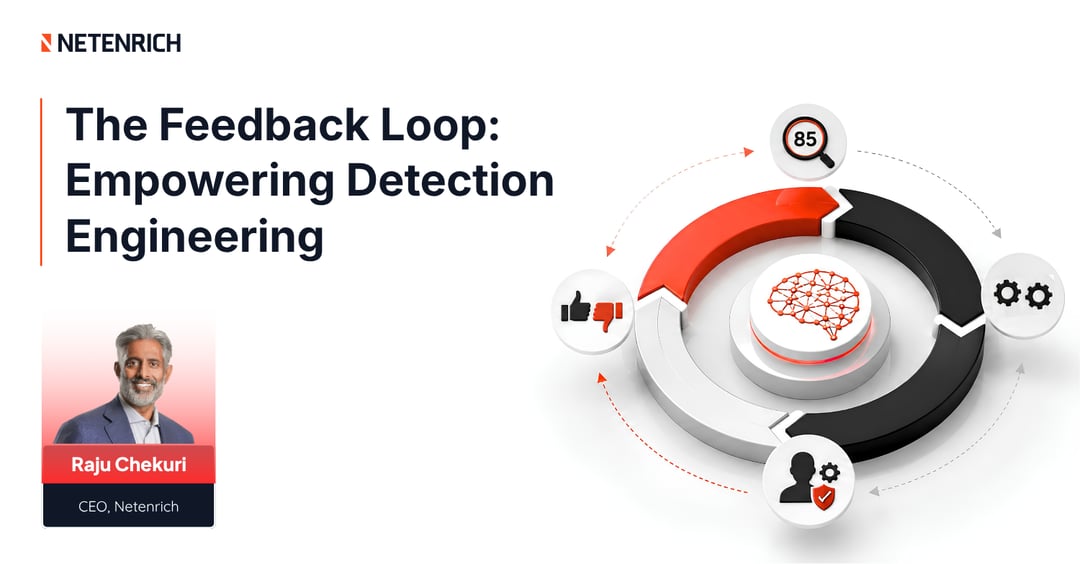
One of the architectural decisions in the Resolution Intelligence Cloud that I am most proud of is one that users rarely see directly: the feedback loop that allows the system to learn from every analyst interaction.
Let me explain what this means concretely and why the design matters.
Every inference the system produces — every scored finding in the situational awareness module, every prioritized alert, every behavioral anomaly surfaced — carries a confidence score and a reasoning trace. The score represents the system's current estimate of the significance of the finding. The reasoning trace shows what data drove that estimate.
When an analyst receives this finding, they interact with it:
| Operational Vector | Legacy Static SIEM Alerting | Feedback-Driven Detection Engineering |
| Logic Maintenance | Manual rule tuning based on periodic post-incident reviews. | Continuous algorithmic calibration via real-time analyst feedback. |
| Alert Evaluation | Binary trigger (alert fires or doesn't). | Dynamic confidence scoring paired with explicit reasoning traces. |
| Noise Reduction | Dependent on manual exclusion lists and whitelist filters. | Automated negative reinforcement applied to benign false positives. |
| Data Integration | Siloed log parsing tied to legacy SIEM tables. | Native normalization across UDM security data lakes. |
The automatic learning loop observes outcomes. When a finding is confirmed significant, the model parameters that produced that score receive positive reinforcement. When a finding is determined benign, the parameters that produced the false positive receive negative reinforcement. This happens continuously, without requiring explicit analyst action beyond the normal investigation workflow.
The human signal loop is different and, I would argue, more important. When an analyst explicitly rates a finding as useful or not useful - the like/dislike mechanism - they are providing direct feedback on the quality of the reasoning, not just the accuracy of the outcome. A finding can be accidentally correct while the reasoning was unsound. A finding can be technically wrong while the reasoning identified a genuine pattern worth investigating further.
This distinction is what I mean when I say the system is learning the honesty and integrity of its scoring - not just whether it was right, but whether it was trustworthy in how it arrived at being right. These are different questions. Most ML feedback systems only ask the first.
The architecture is conceptually related to reinforcement learning from human feedback — the technique that made large language models substantially more useful and trustworthy. Applied to security intelligence scoring, it produces a system that improves in two dimensions simultaneously: accuracy of score calibration and quality of reasoning.
Across 200-plus customer environments, with analyst feedback accumulating every hour, the learning compounds. The system gets smarter from every environment and every analyst interaction. The institutional and domain memory grows not just in volume but in calibration quality.
This is the flywheel that makes the Resolution Intelligence Cloud more valuable over time — not just because more data accumulates, but because the system's judgment improves continuously from the feedback of the skilled analysts who work with it.
Ready to move beyond static alert rules and empower your detection engineering team with real-time feedback loops? Fast-track your security operations with Netenrich to deploy an AI-driven, Agentic SOC.

*Part of my ongoing series on data science and the future of security operations.*
The best source of information for Agentic SOC and Cyber Risk Operations best practices. Join us.