
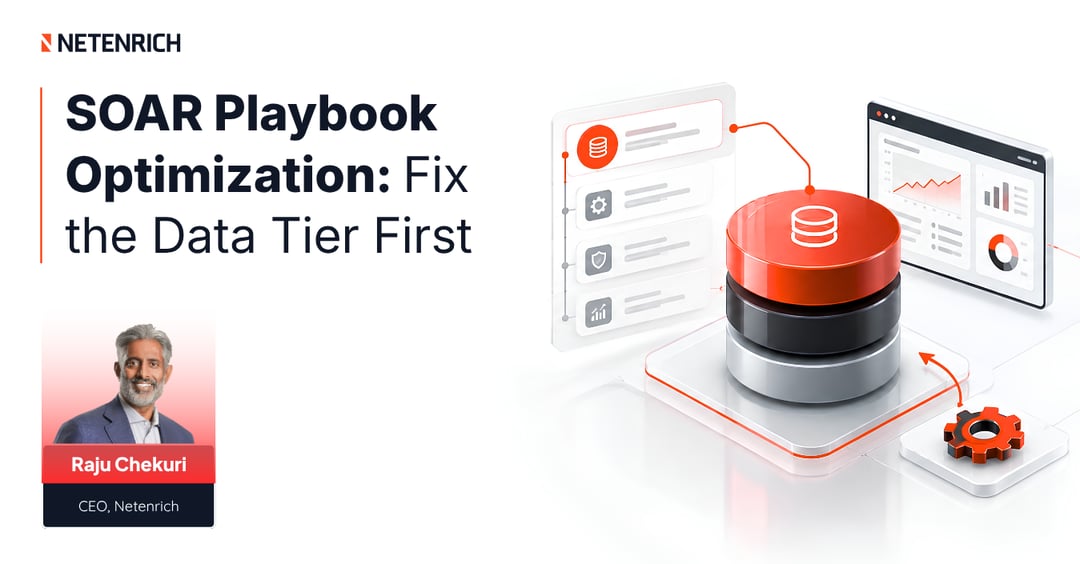
SOAR Playbook Optimization: Fix the Data Tier First
.webp?width=30&name=Raju%20(1).webp) Raju Chekuri: 30/09/2026
Raju Chekuri: 30/09/2026
Digital Pulse: A Book by our CEO

Platform
Featured Videos

Digital Pulse: A Book by our CEO
Digital Pulse: A Book by our CEO
Published on September 30, 2026 | Last updated on September 30, 2026 | 2 min read
Security Orchestration, Automation and Response was built around a sound premise: security workflows involve too many manual steps, too many context switches, and too much repetitive work for the alert volumes that modern environments generate.
Automated SOAR playbooks that orchestrate actions across security tools - alert received, context retrieved, investigation initiated, response executed - would free analyst capacity for the work that actually requires human judgment.
However, most enterprise deployments have not delivered on the full promise of this premise. The operational bottleneck is rarely the orchestration engine itself; it is the quality of the telemetry feeding each SOAR playbook.
When SOAR playbook automation is deployed on top of a detection layer generating high volumes of low-confidence alerts - as is common when detection logic operates on raw, unenriched data - it automates the handling of those alerts.
Automated lookup, automated ticket creation, automated initial triage, automated notification routing. This reduces manual work. But it is automating the management of noise. The underlying detection quality problem is not addressed. SOAR makes a problematic situation more efficient without solving it.
The playbook libraries that mature SOAR deployments accumulate are often a symptom of this dynamic. Complex playbooks exist not because the security scenarios they handle are complex but because the data quality problems in the detection layer require elaborate handling.
In short: SOAR playbook complexity reflects the underlying data quality deficit.
When the detection layer operates on normalized, enriched, entity-resolved data and produces high-confidence alerts with full contextual information already attached, the nature of what SOAR is handling changes fundamentally. The alerts are high-confidence. The context is already present. The entity is already resolved. The playbook can focus entirely on the response workflow rather than carrying data quality handling.
More importantly, the response workflows that become practical at high confidence are substantially more powerful. Not "look up the IP in threat intelligence and create a ticket" but "confirm the scope of the potential compromise through automated access graph traversal, initiate evidence collection from all affected systems, assess blast radius and identify systems that may need isolation, prepare a briefing for the security leadership team with full investigation context, and present a containment recommendation to the analyst for approval before execution." These are genuinely complex, genuinely valuable multi-step workflows. They require the kind of high-confidence detection input that clean data makes possible.
Fix the data foundation. SOAR delivers what it was designed to deliver.
Tired of writing complex SOAR playbooks just to clean up raw alert noise and fetch missing asset context? Fast-track your security operations with Netenrich to deploy normalized, entity-resolved telemetry that turns your automated workflows into high-confidence response engines.

*Part of my ongoing series on data science and the future of security operations.*
The best source of information for Agentic SOC and Cyber Risk Operations best practices. Join us.

.png?width=337&height=172&name=Why%20wrong%20layer%20correlation%20drives%20(1).png)
.png?width=337&height=172&name=Security%20data%20pipeline%20OG%20Image%20(3).png)