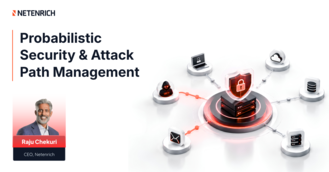
Probabilistic Security & Attack Path Management
.webp?width=30&name=Raju%20(1).webp) Raju Chekuri: 15/10/2026
Raju Chekuri: 15/10/2026
Digital Pulse: A Book by our CEO

Platform
Featured Videos

Digital Pulse: A Book by our CEO
Digital Pulse: A Book by our CEO
Published on July 21, 2026 | Last updated on July 21, 2026 | 2 min read
The Moment I Understood What We Were Really Building
About two years into the Netenrich 2.0 build, I had a conversation with one of our senior data scientists that I keep returning to.
We were reviewing the outputs of the ontology engine running against a specific customer environment - a mid-sized financial services firm with a complex mix of cloud workloads, on-premise infrastructure, third-party integrations, and a large contractor workforce. The ontology had built a semantic relationship model of the environment: not just the assets classified by type but the full web of connections between them. Which systems depended on which. Which accounts had access to what. Which business processes flowed through which digital infrastructure. Which third parties touched which systems.
Looking at this model, my data scientist said something I have not forgotten: "This is not a security graph. This is a map of how this company lives."
She was right. And that insight reframed everything we were building, fundamentally shifting our long-term approach to how we look at cyber risk quantification.
We had been describing the Resolution Intelligence Cloud as a security intelligence platform - which it is. But the more fundamental thing we were building was a continuously updated, semantically connected model of the living digital reality of an enterprise. How it operates. How its components relate to each other. What its normal rhythm looks like. The specific way it breathes.
Every enterprise has a unique version of this. Two financial services firms with identical technology stacks have different digital tones - because the way their people use those systems, the specific workflows they have built, the particular dependencies they have accumulated, the rhythm of their operations are specific to them.
Understanding the digital tone of an enterprise is the prerequisite for protecting it. Not because protection requires a complete model of the environment - it always requires dealing with incomplete information. But because security is fundamentally about recognizing when something disturbs the normal pattern, when something doesn't fit the tone, when the rhythm is wrong in a way that warrants investigation. This operational baseline is what transforms abstract threat modeling into precise cyber risk quantification.
| Risk Vector Metric | Legacy Risk Scoring Models | Graph-Based Cyber Risk Quantification |
| Asset Evaluation | Static inventory lists isolated by IP block or device type. | Dynamic dependency models mapping multi-cloud infrastructure and business-critical workflows. |
| Threat Priority | Raw CVSS severity scores applied regardless of actual exposure. | Real-time Likelihood and Confidence scores mapped directly to the enterprise graph topology. |
| Operational Impact | Generalized, subjective risk estimates based on broad industry averages. | Data-driven Impact scoring calculated by system relationship density and business process dependencies. |
That recognition does not require a rule that anticipated the specific adversary technique. It requires genuine understanding of what normal looks like for this specific enterprise, built from its own operational data, continuously maintained.
This is the insight that has driven every architectural decision in the Resolution Intelligence Cloud since that conversation. We are not building a detection platform that sits on top of enterprise data. We are building a living model of the enterprise's digital tone, and security intelligence is the natural output of watching that model continuously and attentively.
Stop managing risk via static, out-of-context spreadsheets. Deploy a Netenrich Agentic SOC in 30 Days to turn your raw telemetry into data-driven cyber risk quantification, consolidate your architecture into a unified semantic graph, and achieve an ironclad 3-minute threat triage SLA.

*Part of my ongoing series on data science and the future of security operations.*
The best source of information for Agentic SOC and Cyber Risk Operations best practices. Join us.