LIC Scoring: Quantifying Posture & Cybersecurity ROI
.webp?width=30&name=Raju%20(1).webp) Raju Chekuri: 10/09/2026
Raju Chekuri: 10/09/2026
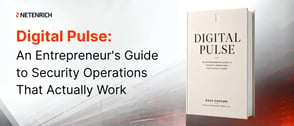
Digital Pulse: A Book by our CEO
Platform
Featured Videos

Digital Pulse: A Book by our CEO
Digital Pulse: A Book by our CEO
Published on June 16, 2026 | Last updated on July 20, 2026 | 3 min read
Let me tell you something I mean without any false modesty: I genuinely love being the underdog.
Not in the abstract sense in which people say they root for the underdog in sports. In the specific, daily, operational sense of building a company that does not have the resources, the brand recognition, or the structural advantages of the companies it competes against — and winning customers anyway, through the quality of what it builds.
The market surrounding the Security Operations Center (SOC) is not a level playing field. It never has been. The largest vendors dominating the Security Operations Center (SOC) space have sales forces that dwarf our entire headcount. They have Gartner analysts writing about them. They have partner ecosystems built over decades. They have the ability to acquire any capability gap that emerges in their portfolio and brand it into their platform story within a quarter.
We have none of that. We focused entirely on perfecting a modern SOC architecture that out-innovates legacy alternatives through four core data pillars:
The underdog position is not comfortable. It requires being excellent every day in ways that well-capitalized competitors do not. When you cannot buy customers, every customer you have chose you on merit. That means every time you fall short of expectations, you feel it acutely — because you know what it cost that customer to choose you over a safer, more recognized alternative.
Scarcity produces something that financial abundance never can: absolute operational discipline.
When you cannot throw money at a hard software engineering problem, you are forced to solve it correctly. When every development decision has to pay for itself in immediate customer value, you make better architectural decisions. When every customer relationship is earned through performance rather than bought over expensive dinners, you protect that data ecosystem with everything you have.
In an era where the traditional Security Operations Center (SOC) is drowning in alert fatigue and runaway log ingestion fees, engineering constraints are what forced us to build an autonomous platform rather than just hiring more tier-1 analysts.
The OpsRamp journey taught me something specific about this. We built OpsRamp to $25M ARR and never made the Gartner Magic Quadrant. HPE acquired it, put their logo behind it, and it appeared in the Magic Quadrant. The technology did not change. The budget behind it did. That is not an indictment of Gartner or HPE. It is just an honest description of how validation gets distributed in this market — and why I do not orient Netenrich around seeking it.
Tired of throwing legacy budgets at a human-speed Security Operations Center (SOC) that still misses critical compromises? Deploy a Netenrich Agentic SOC in 30 Days to achieve 98% autonomous threat resolution and contract-backed 3-minute triage.

In enterprise cybersecurity, having the better answer is the only thing that ultimately matters. It takes longer to win with the better answer. It compounds in ways that market-position wins do not. The customers who choose you because you earned their trust become the strongest advocates you will ever have.
I enjoy the fight. It is genuinely fun. The Goliath has the megaphone. The underdog has the better Security Operations Center (SOC) architecture. I will take that trade every time.
*Part of my ongoing series on data science and the future of security operations.*
The best source of information for Agentic SOC and Cyber Risk Operations best practices. Join us.

.png?width=337&height=172&name=Third%20party%20vendors%20OG%20image%20(3).png)