.jpeg?width=337&height=172&name=Image%20(1).jpeg)
The Operational Shift to Proactive Security
.webp?width=30&name=Raju%20(1).webp) Raju Chekuri: 17/09/2026
Raju Chekuri: 17/09/2026
Digital Pulse: A Book by our CEO

Platform
Featured Videos

Digital Pulse: A Book by our CEO
Digital Pulse: A Book by our CEO
Published on August 6, 2026 | Last updated on August 6, 2026 | 3 min read
The most common failure mode I observe in LLM deployments for security operations is not hallucination in the classic sense - making things up. It is something more subtle: generic accuracy.
The LLM is technically correct about general security concepts and completely useless for the specific investigation the analyst is conducting. When evaluating tools for enterprise AI security, leaders often miss this distinction.
Consider a typical un-grounded LLM output:
"This alert pattern is consistent with lateral movement techniques. Recommend reviewing authentication logs and process execution history."
True. Generic. Tells the analyst nothing they did not already know.
Now compare that generic advice to what happens when you implement LLM grounding and RAG in SOC workflows:
"This alert fired on PROD-DB-03, which is classified as business-critical and hosts the primary customer database. The account that triggered the alert has never previously authenticated to this system type in its 180-day history. The process that executed — sqlcmd.exe — has no behavioral precedent on this system. Two hours ago, the same account authenticated to PROD-WEB-01, which is also outside its historical access pattern. Intelligence received 48 hours ago indicates that the adversary group most active against financial services organizations in your region is using SQLcmd abuse for credential access. Recommend immediate scope assessment including lateral authentication review for this account over the past 24 hours."
That is grounded AI. And grounded is the difference between useful and not.
|
Investigation Dimension |
Generic Un-Grounded LLM Output |
Context-Grounded RAG Output |
|
Contextual Visibility |
Abstract security definitions without asset awareness. |
Deep knowledge of target asset criticality (e.g., PROD-DB-03). |
|
Identity Telemetry |
No knowledge of historical user access patterns. |
Correlates 180-day baseline anomalies across identity graphs. |
|
Threat Intelligence |
Static, outdated public threat signatures. |
Real-time integration of active regional adversary TTPs. |
|
Analyst Actionability |
Vague advice ("review auth logs"). |
Explicit 24-hour scope assessment and lateral containment playbooks. |
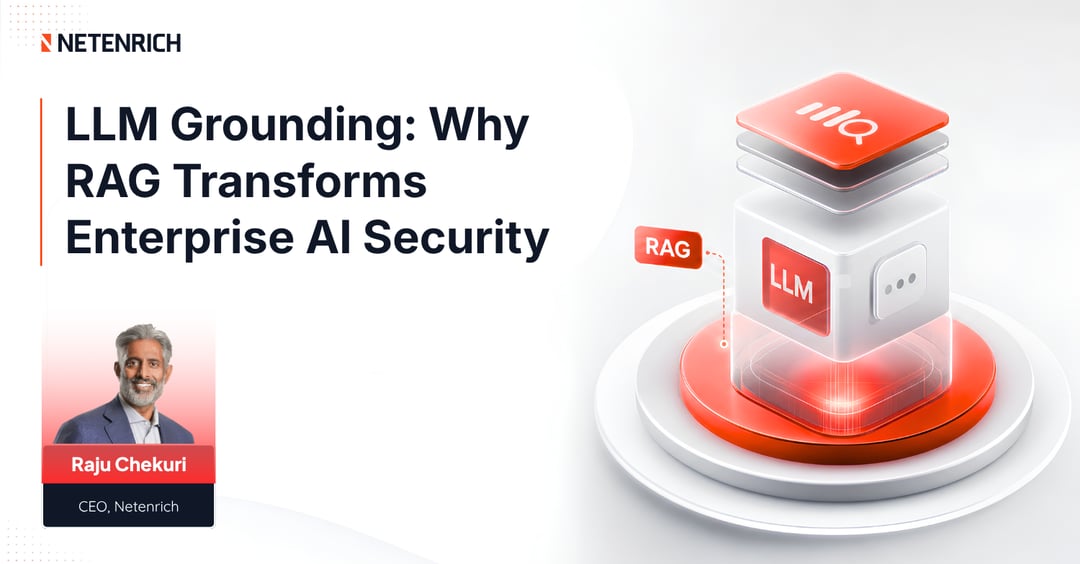
Retrieval-Augmented Generation is the technical mechanism that produces grounding. Rather than relying on the LLM's general training knowledge alone, RAG in SOC architectures dynamically retrieves relevant context from a curated knowledge base - the specific facts about your environment, your assets, your history, your current threat landscape - and provides it as context for the LLM's response at query time.
Building a production-grade RAG knowledge base for security operations within Netenrich and our Resolution Intelligence Cloud™ required significant architectural investment:
The retrieval system that identifies what is relevant to a given query - and does so quickly enough to be usable in real-time investigation workflows - required its own engineering investment on top of the knowledge base itself.
What this engineering investment produces is an LLM-assisted investigation that is:
The LLM is no longer reasoning over general, public security knowledge. It is reasoning over structured, real-time knowledge about your enterprise's unique digital footprint.
Grounding is what makes LLMs genuinely useful in production security operations rather than impressively generic in demos.
Ready to move beyond generic LLM outputs and deploy context-grounded RAG across your security telemetry? Fast-track your security operations with Netenrich to build an AI-driven, Agentic SOC.

*Part of my ongoing series on data science and the future of security operations.*
The best source of information for Agentic SOC and Cyber Risk Operations best practices. Join us.