
Deterministic Defense vs Probabilistic Offense Mismatch
.webp?width=30&name=Raju%20(1).webp) Raju Chekuri: 13/10/2026
Raju Chekuri: 13/10/2026
Digital Pulse: A Book by our CEO

Platform
Featured Videos

Digital Pulse: A Book by our CEO
Digital Pulse: A Book by our CEO
Published on October 13, 2026 | Last updated on October 13, 2026 | 3 min read
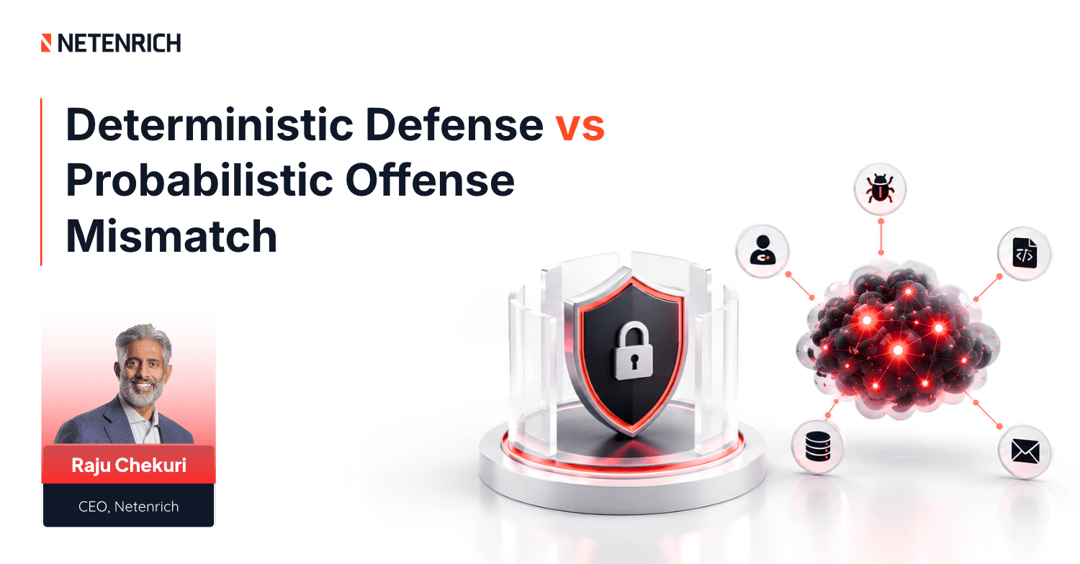
I want to name something clearly that I think explains more about why well-run security programs still experience breaches than almost any other single factor: the structural mismatch between deterministic defense and probabilistic offense.
Security operations centers are fundamentally deterministic.
This is a rational, efficient model for handling known threats at the scale enterprise environments require. However, it has one fatal architectural limit: it can only address what it was designed to address. The boundary of your rule-based detection logic is the hard boundary of your defense.
Adversaries, by contrast, are entirely probabilistic. They approach a target with an overarching goal and a portfolio of potential approaches. They allocate effort toward paths showing progress and pivot away from those that are blocked. They accept a high rate of failure across individual attempts as the simple cost of discovering the single route that works.
They do not stop when an approach is blocked; they adapt. Adversaries run a continuous optimization against your environment, not a static process against it.
This operational asymmetry means that a security program processing known detections with world-class efficiency will still be systematically surprised by adversaries who discover paths that static logic was never built to monitor.
And there are always such paths - because the detection logic was designed by humans with a finite threat model, and adversaries are continuously evolving the techniques they use to get around it.
In 2026, generative AI has made this structural mismatch more acute. Automated Reconnaissance: Threat actors scan, enumerate, and discover misconfigurations across hybrid clouds in minutes.
The defensive response cannot be adding more detection rules. More deterministic capability does not close a probabilistic gap. Stacking hundreds of new rules into your SIEM only creates more query debt, alert fatigue, and maintenance overhead without altering the underlying math.
The strategic response is to introduce probabilistic thinking as a parallel operational mode: actively modeling what the adversary would most likely do in this specific environment given the current threat landscape, directing analytical capacity toward those probable approaches, and looking for evidence of activity that hasn't yet triggered detection.
Rather than relying strictly on rule-based detection to sound an alarm, modern SecOps teams implement proactive defense vectors:
Operating probabilistically alongside a deterministic detection system is fundamentally an organizational and cultural change before it is a technology change.
The analytical capabilities - adversary path modeling, behavioral analytics tuned to adversary techniques, and AI threat hunting - are already proven and operational. The leadership decision to allocate engineering and analytical capacity away from pure alert clearance and into continuous adversary modeling is what has to come first.
That decision belongs to CISOs, CTOs, and CIOs. It is an executive mandate, not a vendor recommendation.
Tired of maintaining brittle SIEM rules while adversaries discover novel paths through your environment? Fast-track your security operations with Netenrich to operationalize real-time adversary modeling, unified telemetry, and a proactive Agentic SOC.

*Part of my ongoing series on data science and the future of security operations.*
The best source of information for Agentic SOC and Cyber Risk Operations best practices. Join us.