Suma Ballal


Probabilistic Security & Attack Path Management
.webp?width=30&name=Raju%20(1).webp) Raju Chekuri: 15/10/2026
Raju Chekuri: 15/10/2026
Digital Pulse: A Book by our CEO

Platform
Featured Videos

Digital Pulse: A Book by our CEO
Digital Pulse: A Book by our CEO
Published on June 9, 2026 | Last updated on July 8, 2026 | 5 min read
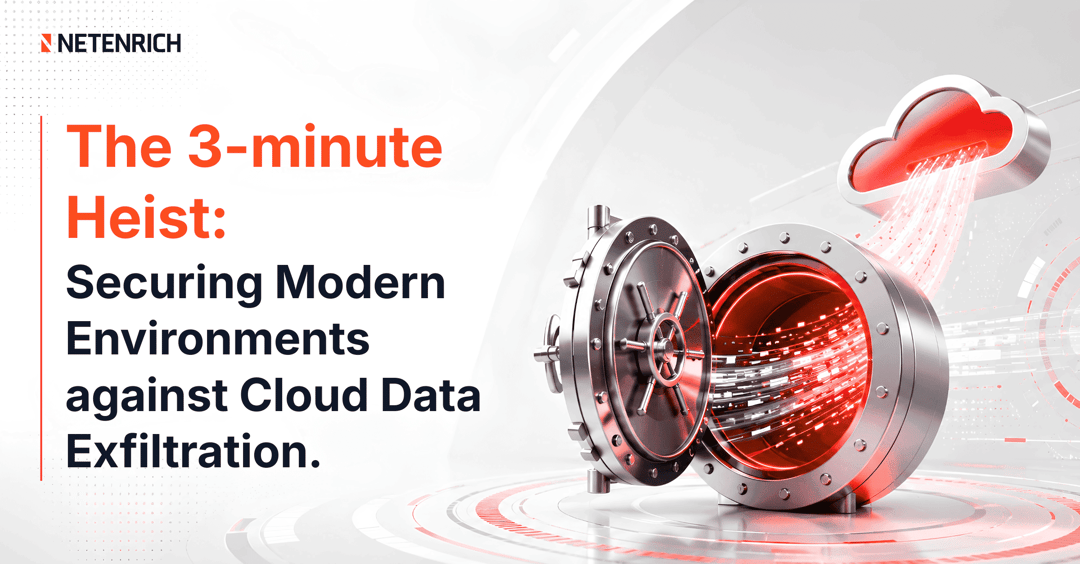
Modern cloud environments have fundamentally changed how enterprise data is stored, accessed, and operationalized. Platforms like Google BigQuery now support large-scale analytics, AI initiatives, and cross-functional collaboration across distributed cloud infrastructures. However, as organizations centralize sensitive business data within cloud-native platforms, security teams increasingly face operational challenges around identity governance, cross-boundary data movement, and monitoring legitimate-but-risky activity across cloud-native workflows.
Today’s attackers increasingly leverage legitimate cloud identities, native services, automation frameworks, and non-human identities (NHIs) to access and move data rapidly across environments — often blending into normal operational behavior. Many organizations still rely on static detection logic and isolated monitoring workflows that were not designed for dynamic, identity-driven cloud ecosystems, making it increasingly difficult to validate whether existing controls can effectively detect evolving attack paths before sensitive data leaves the organization.
Google BigQuery increasingly serves as a centralized analytics layer for sensitive operational and business data across modern enterprises. Its ability to support large-scale analytics, AI workflows, and distributed cloud operations makes it foundational to many cloud-native environments.
At the same time, the growing use of non-human identities (NHIs), service accounts, automation pipelines, and cross-cloud integrations introduces new operational visibility challenges. Security teams must now monitor how sensitive data moves across identities, services, projects, and external boundaries; often within legitimate cloud-native workflows.
Defending a cloud data warehouse requires a deep, tactical understanding of how attackers exfiltrate data from cloud platforms The modern cloud kill chain for data warehouses typically follows these mapped phases to showcase exactly how attackers exfiltrate data from cloud platforms:
| Threat Stage (MITRE Tactic) |
Attacker Technique | Execution Details in GCP BigQuery |
| Discovery (TA0007) |
Reconnaissance & Schema Mapping (T1213.002: Data from Information Repositories) |
Before stealing data, attackers execute SQL queries against INFORMATION_SCHEMA or __TABLES__ to map the environment and uncover columns named "SSN", "credit_card", or "password". |
| Collection (TA0009) |
Discovery & Data Sampling (T1530: Data from Cloud Storage) |
Moving beyond simple listing, attackers execute small sampling queries to verify the high-value nature of the data before committing to a massive, potentially noisy extraction. |
| Staging (TA0003) |
Internal Staging via CTAS (T1074: Data Staged) |
Attackers aggregate data into a single staging dataset using "Create Table As Select" (CTAS) queries. This bypasses network egress alerts because the copy stays within Google's infrastructure. |
| Exfiltration (TA0010) |
Public Exposure & Misconfiguration (T1537: Transfer Data to Cloud Account) |
A high-risk mechanism where an attacker (or human error) grants allAuthenticatedUsers IAM access to a dataset, making thousands of sensitive records globally accessible instantly. |
| Exfiltration (TA0010) |
Cloud Primitive Egress (T1537: Exfiltration Over Web Service) |
The point at which sensitive data crosses organizational boundaries. Achieved by leveraging native BigQuery extract jobs to push data directly to an external, attacker-controlled GCS bucket (Bring Your Own Bucket). |
| Exfiltration (TA0010) |
Agentic Exfiltration (Shadow AI) (Emerging Threat Vector) |
Generative AI agents are becoming primary DB users. Prompt injection attacks convince an internal Vertex AI agent to query sensitive data and output it to an external, unauthorized location. |
Security cannot exist without visibility. The foundational step in protecting a cloud data warehouse involves a comprehensive understanding of your data assets and attack surface.
Traditional security vendors approach the threat landscape with a reactive, one-time mindset. When faced with dozens of potential data egress paths—from multi-cloud connectors to serverless proxies—legacy systems attempt to write rigid, isolated rules for every single vector.
Effective cloud detection increasingly depends on continuously validating identity behaviors, anomalous data movement, and operational exposure paths rather than relying solely on isolated detections.the continuous assessment of attack surfaces and the consolidation of threat vectors through behavioral analytics.
By utilizing comprehensive simulation frameworks that continuously test against both basic exfiltration patterns and advanced channels, visibility is vastly expanded. Through deep analysis of an environment's behavioral baseline, Netenrich eliminates the need for dozens of fragile rules. Instead, numerous complex egress scenarios are consolidated into a highly focused set of robust, behavior-based detection models engineered to surface early data exfiltration indicators.
This approach correlates identity activity with real-time data-plane telemetry to identify operational anomalies that traditional detections frequently miss. By analyzing key indicators within audit telemetry and distinguishing between human and non-human identity activity, organizations can surface structural anomalies earlier in the attack lifecycle.
Demonstrating the efficacy of this Cross-Telemetry Detection Framework requires examining production-ready coverage across critical cloud perimeters. True visibility is achieved not by looking at single events, but by connecting the dots:
Operationalizing this protection requires a structured approach to prevention and response:
As organizations continue centralizing sensitive workloads and business-critical data into cloud-native analytics platforms, security operations must evolve beyond isolated detections and static monitoring models.
Protecting modern cloud environments requires operational awareness across identities, data movement patterns, automation workflows, and cross-boundary activity. More importantly, organizations must validate whether existing controls can effectively detect and contain realistic cloud-native attack paths operating at cloud speed.
Organizations best positioned to reduce exposure are those that combine identity-aware monitoring, contextual analytics, operational baselining, and continuous validation across cloud services and data environments. Netenrich delivers this paradigm shift via its Agentic SOC platform - combining deep telemetry correlation with an automated digital workforce of specialized AI security agents to turn data exfiltration prevention into an autonomous, machine-speed capability.
Organizations evaluating the maturity of their cloud data protection strategies should begin by validating how sensitive data moves across identities, cloud services, APIs, and external boundaries. Continuous validation of attack paths, operational baselines, and anomalous activity can help security teams better understand whether existing controls are capable of detecting modern cloud-native threats before sensitive data leaves the environment.
Ready to transition from reactive monitoring to autonomous assurance?
Discover how Netenrich scales your contextual visibility, maps sophisticated cloud dependencies, and achieves definitive compliance.

The best source of information for Agentic SOC and Cyber Risk Operations best practices. Join us.