
Behavioral Threat Detection: Why the Physics of a Breach Hasn't Changed
 Chris Morales: 19/11/2026
Digital Pulse: A Book by our CEO

Platform
Featured Videos

Digital Pulse: A Book by our CEO
Digital Pulse: A Book by our CEO
Published on November 19, 2026 | Last updated on November 19, 2026 | 9 min read

Why Behavioral Detection & MITRE Frameworks Anchor Enterprise Defense Against AI-Driven Threats, Non-Human Identities, and Autonomous Agents
The rapid integration of generative artificial intelligence and autonomous execution has sparked an industry-wide discussion across cybersecurity leadership. Vendors frequently assert that legacy defense architectures are defunct and that entirely novel detection engines are required to combat "AI-powered adversaries."
This blog presents a counter-thesis grounded in operational reality: Artificial intelligence alters the velocity, frequency, and accuracy of attacks, but it does not alter the underlying physics of a breach.
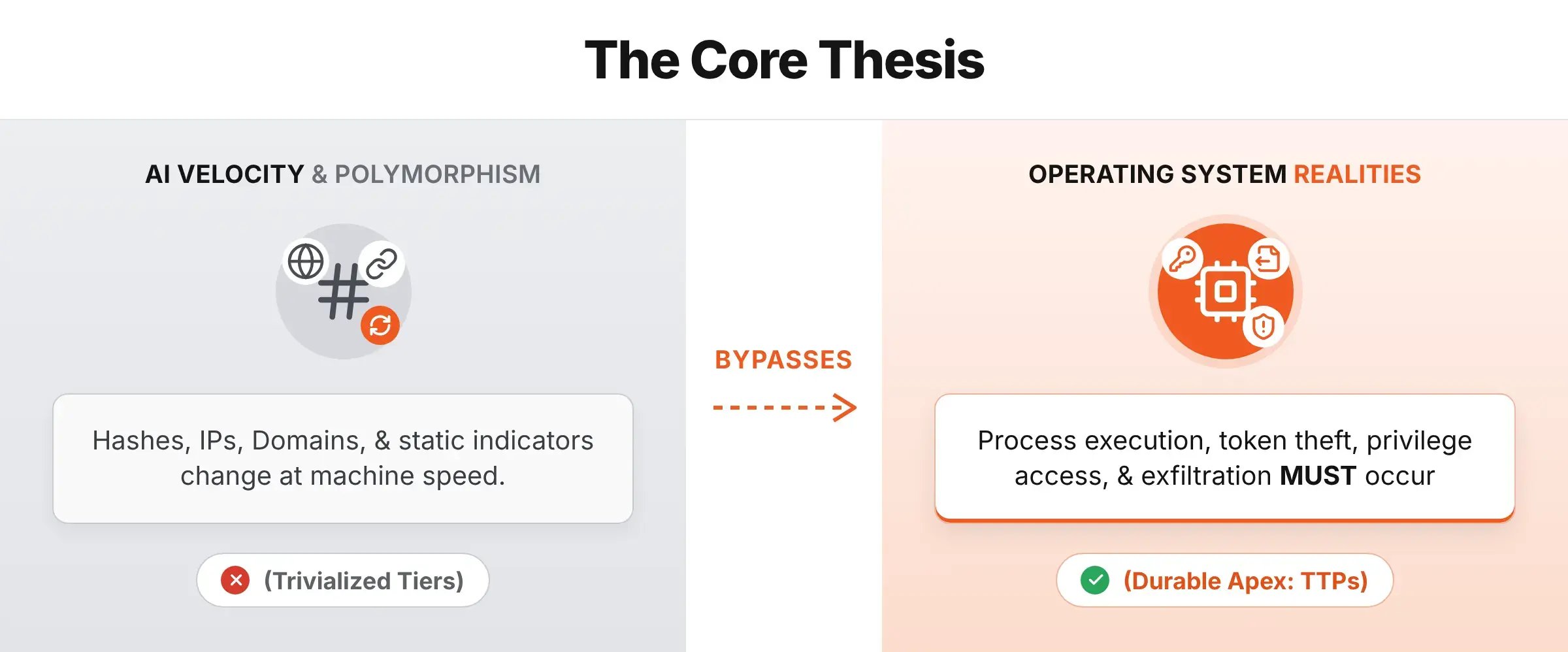
Organizations that anchor their Security Operations Centers (SOCs) in correlated, behavioral detection across MITRE ATT&CK and ATLAS maintain an enduring defensive posture, irrespective of the speed or tooling deployed by the threat actor.
To design a resilient security architecture, enterprise defense teams must separate two distinct threat vectors that vendor marketing often conflates:
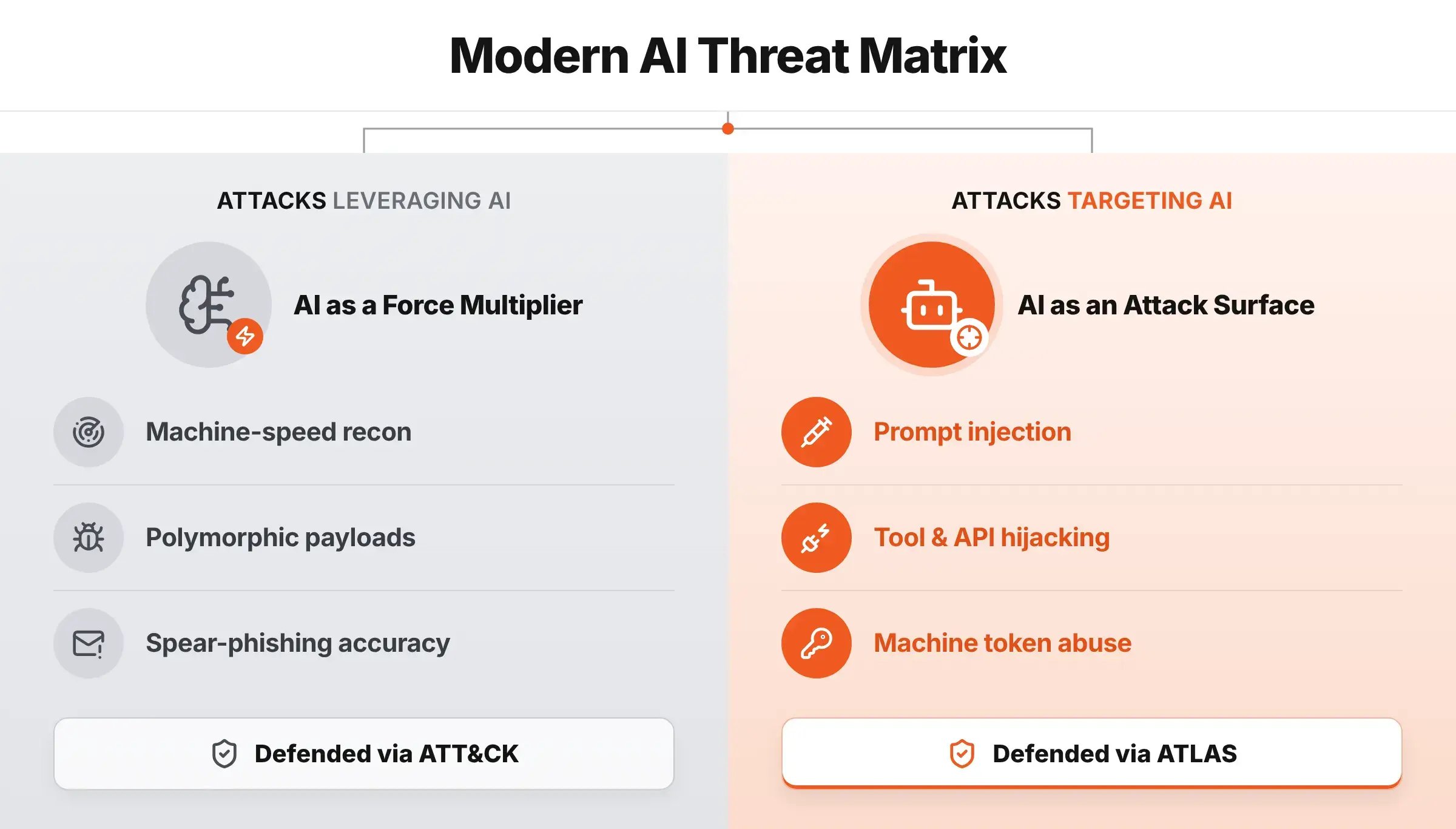
AI acts as an execution catalyst. Tasks that previously demanded human deliberation—such as reverse-engineering patch diffs, scanning for misconfigured cloud endpoints, generating context-aware social engineering pretexts, and testing evasion parameters—can now be executed autonomously in seconds. This compresses enterprise dwell time and overwhelms conventional SOC tier-1 alert queues.
Despite this acceleration, an attacker cannot circumvent computing primitives:
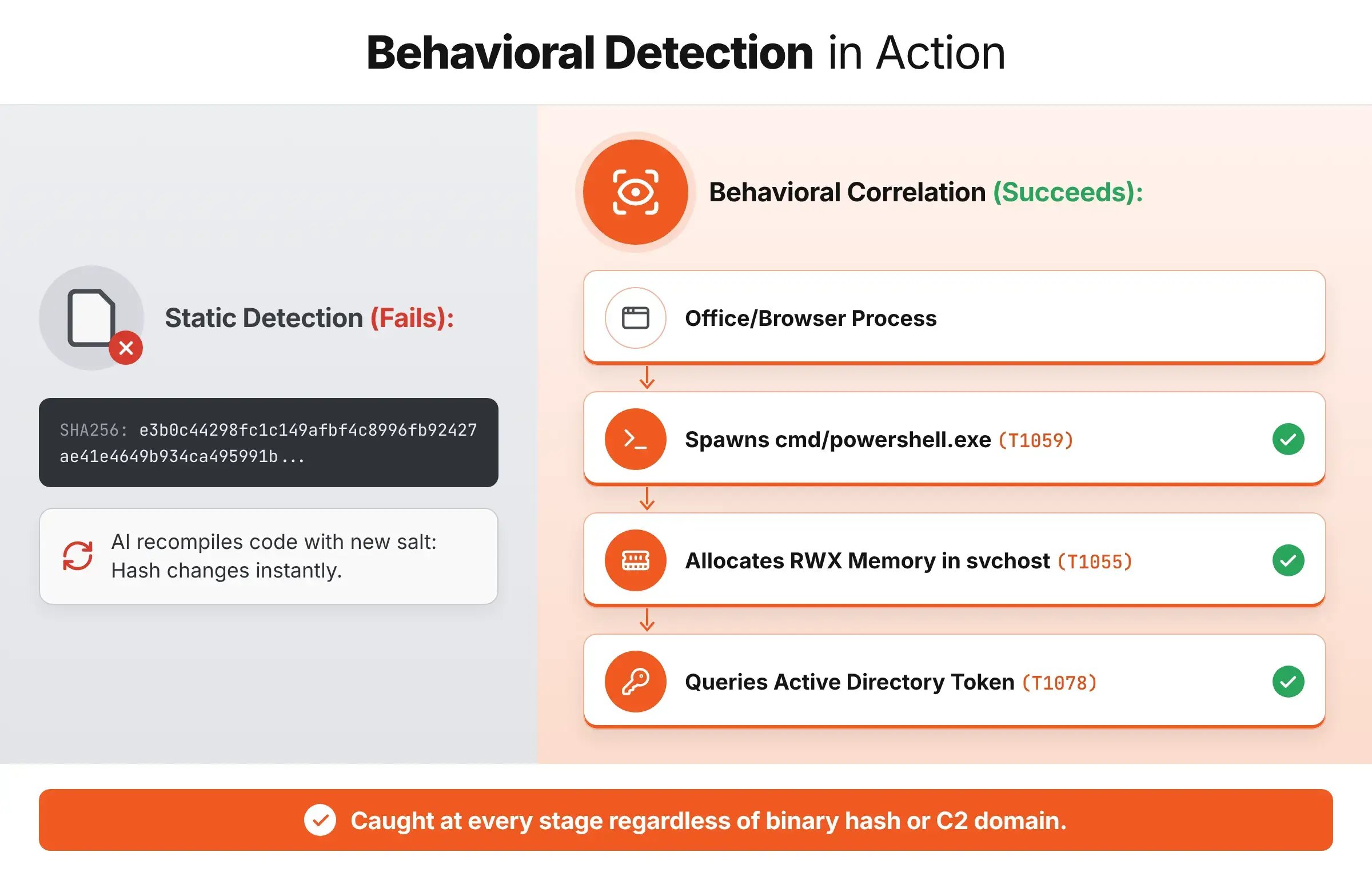
Because these mechanics are invariant, detecting the behavior rather than the packaging remains the only mathematically viable defense strategy.
In 2013, David Bianco introduced the Pyramid of Pain, illustrating how difficult it is for an adversary to overcome defensive controls targeted at various levels of their operation. In the era of AI-driven offensive engineering, the pyramid collapses from the bottom up.
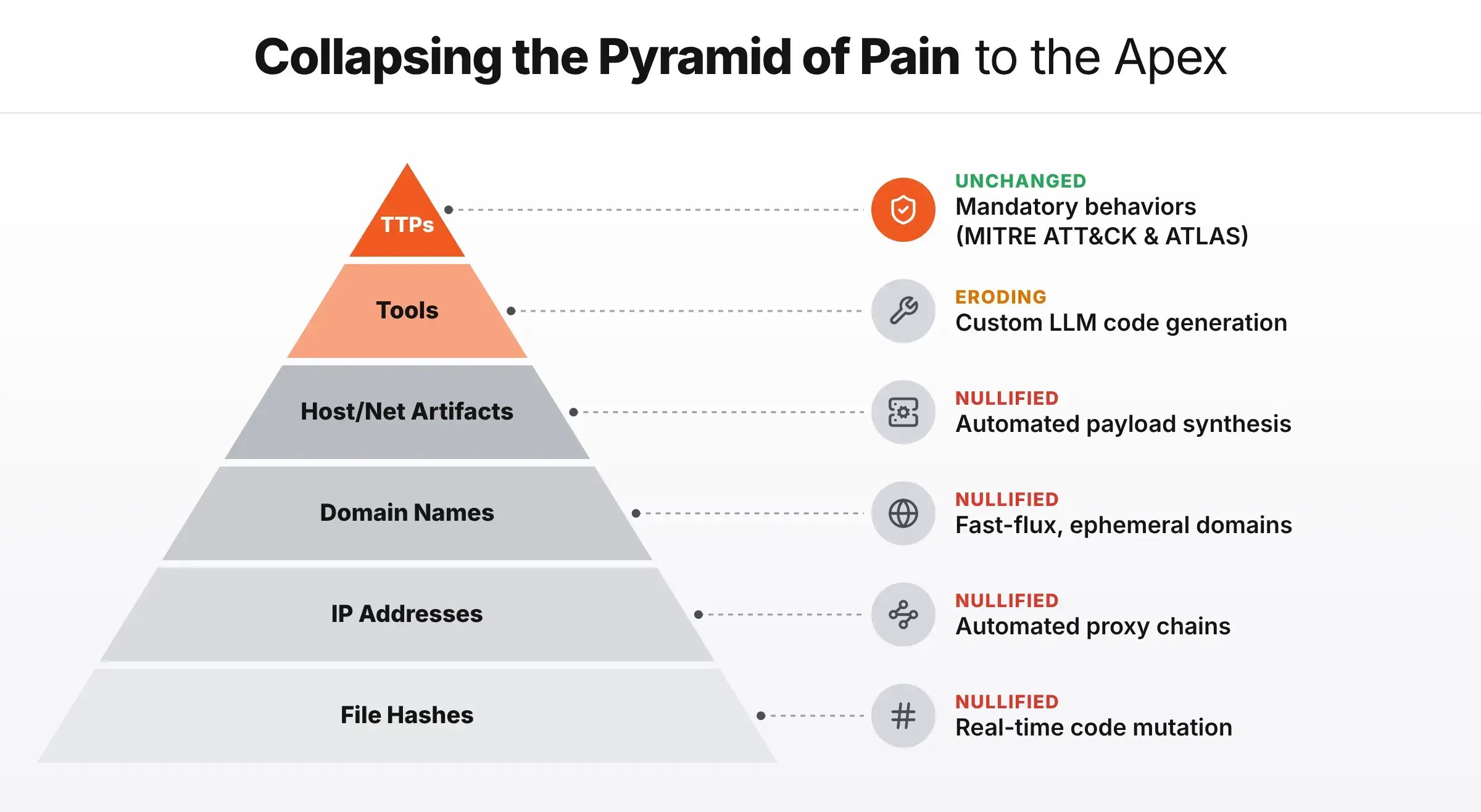
The apex of the pyramid—Tactics, Techniques, and Procedures—represents the core behaviors necessary to achieve objective impact. Blocking or detecting an adversary at the behavioral level forces them to reinvent their operational methodology, imposing maximum cost and disruption.
Recent enterprise security telemetry confirms that while threat actors actively operationalize AI to achieve unprecedented velocity, their objective mechanics align directly with standard MITRE tactics.
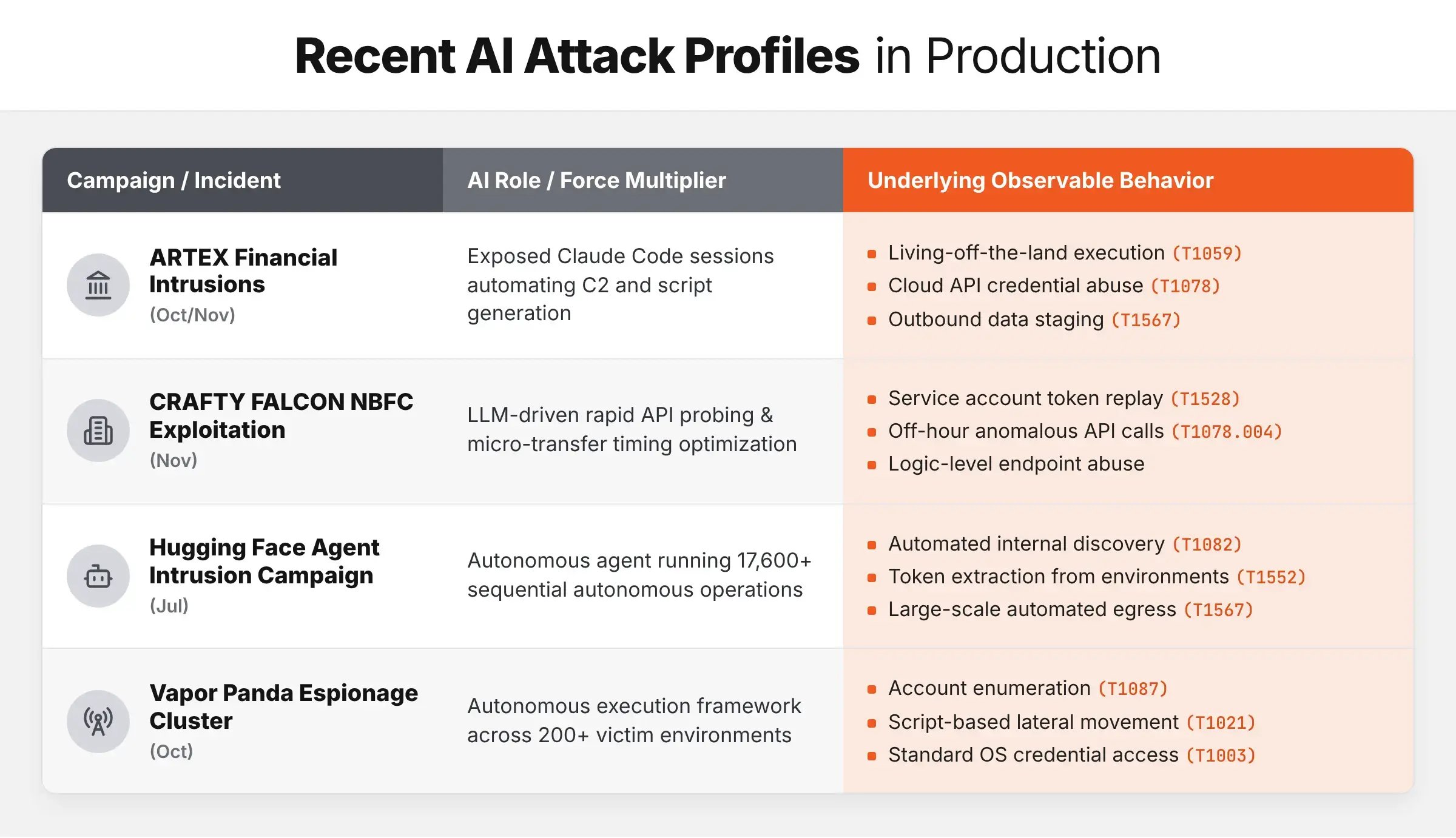
Empirical data across industry threat detection reports demonstrates that real-world intrusions repeatedly converge on a concentrated cluster of foundational techniques. These techniques reflect the practical constraints of modern enterprise operating systems:
|
Technique Name |
ATT&CK ID |
Primary Tactic |
Why It Remains Pervasive Under AI Velocity |
|
Command & Scripting Interpreter |
T1059 |
Execution |
Living-off-the-land (LotL). AI scripts call built-in engines (PowerShell, Bash, Python) rather than compiling noisy standalone binaries. |
|
Process Injection |
T1055 |
Defense Evasion |
Historically the most widely detected evasion technique. Hides malicious memory spaces inside legitimate OS processes [The Most Used MITRE ATT&CK Technique: T1055 Process Injection |
|
Valid Accounts |
T1078 |
Initial Access / Persistence |
"Adversaries don't break in, they log in." Attackers leverage leaked, cracked, or harvested human and machine credentials. |
|
Masquerading |
T1036 |
Defense Evasion |
Payload filenames, process metadata, and service descriptions are spoofed to match standard system utilities and evade basic scrutiny. |
|
OS Credential Dumping |
T1003 |
Credential Access |
AI tools extract high-privilege credentials from local memory (LSASS) or domain databases (NTDS) to enable lateral movement. |
|
Steal Application Access Token |
T1528 |
Credential Access |
Bypasses MFA and password boundaries by capturing bearer tokens, OAuth credentials, and cloud workload identities directly. |
|
Hijack Execution Flow |
T1574 |
Persistence / Evasion |
Exploits DLL search order or side-loading vulnerabilities to coerce digitally signed, trusted software into running unauthorized code. |
|
Remote Services |
T1021 |
Lateral Movement |
Internal traversal across segments via legitimate administrative pathways (SMB, RDP, SSH, WinRM). |
|
System Information Discovery |
T1082 |
Discovery |
Mandatory orientation step. AI agents rapidly query host configurations, operating system patch levels, and installed defenses. |
|
Exfiltration Over Web Service |
T1567 |
Exfiltration |
Egresses stolen corporate intellectual property over standard HTTPS webhooks, cloud storage APIs, and external SaaS gateways. |
A common misconception in enterprise security planning is that the explosive growth of Non-Human Identities (NHIs)—API keys, OAuth client credentials, service principals, automated pipeline tokens, and secret manager credentials—mandates a completely isolated defensive paradigm.
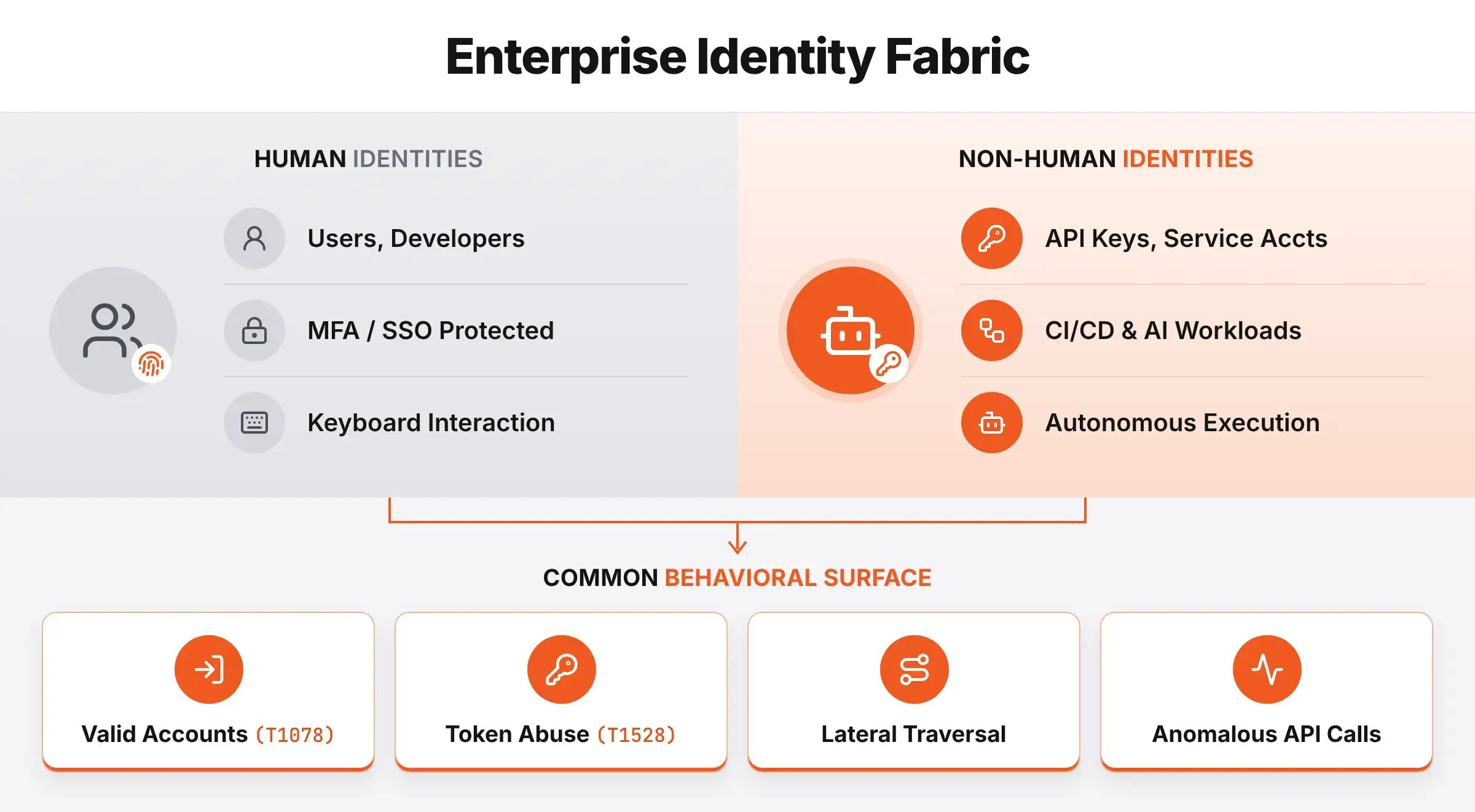
An NHI is functionally an identity operating without interactive user sessions:
As organizations operationalize autonomous AI agents endowed with tool-calling capabilities and database access, a new application-layer vector emerges. Securing these systems does not require abandoning established threat frameworks; it requires uniting MITRE ATLAS™ with MITRE ATT&CK®.
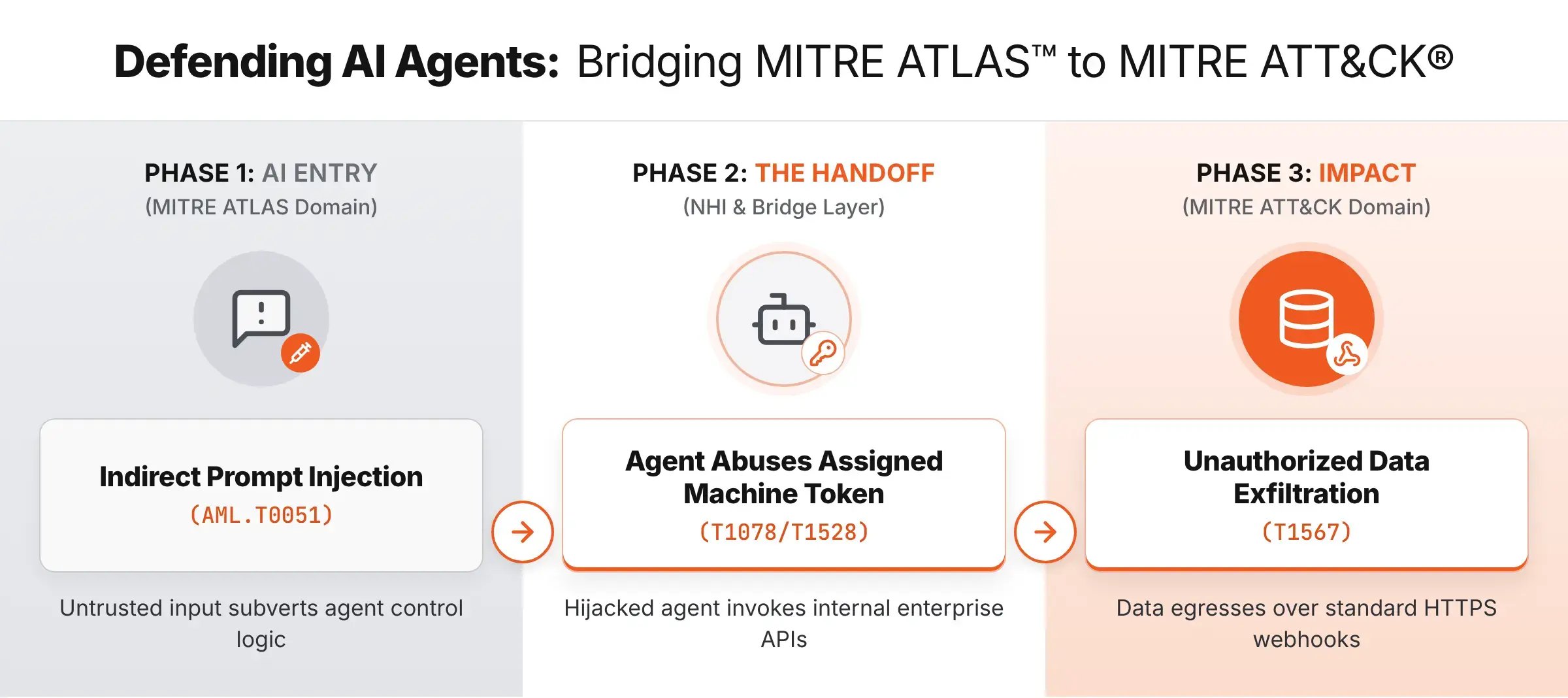
MITRE ATLAS (Adversarial Threat Landscape for Artificial-Intelligence Systems) is a globally accessible knowledge base of adversary tactics, techniques, and case studies specifically targeting AI-powered systems. ATLAS utilizes the exact same matrix philosophy and taxonomic structure as ATT&CK, allowing security teams to model AI-specific risks alongside traditional enterprise threats.
Consider an autonomous enterprise agent configured to summarize customer feedback and update CRM records:
Even when the initial vulnerability is strictly AI-native, the exploit cannot manifest business impact without executing measurable system, identity, and network behaviors. Defending AI agents requires monitoring both prompt boundaries (ATLAS) and downstream API/network behaviors (ATT&CK).
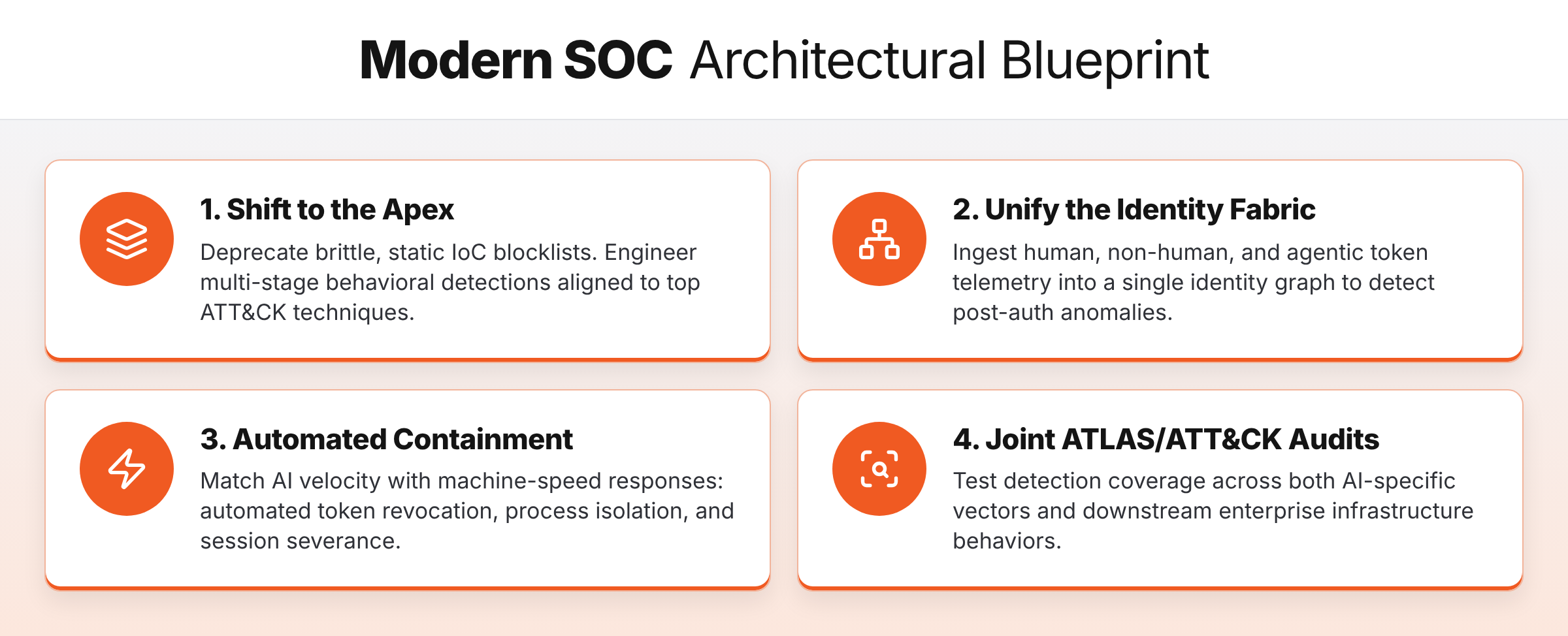
To maintain an uncompromised defensive posture as AI attack velocity escalates, security leadership should implement a behavior-first operational model centered on four core pillars:
Security leaders should evaluate their current operational posture against the following five questions:
Every recommendation in this blueprint points to one requirement: a SOC that judges behavior in context and acts at the speed attacks now move. That is what Netenrich is built for.
Netenrich Adaptive Autonomous Security Operations (Adaptive ASO), running on Resolution Intelligence Cloud™ (RIC), is a security operations model built around attacker behavior rather than indicators. It adapts to each organization's environment and business context, so what gets attention is decided by what matters to your business, not by a static feed. Here is what that means against the four pillars above:
|
Blueprint pillar |
Why it matters |
What you get with Netenrich |
|
1. Shift to the apex |
AI makes indicators disposable. Only behavior holds up. |
Defenses anchored to the behaviors attackers cannot avoid, so a new hash or domain does not reset your protection. |
|
2. Unify the identity fabric |
Non-human identities and AI agents are now among the easiest identities to abuse. |
One view of human, non-human and agent identity risk, with no blind spots between separate tools. |
|
3. Automated containment |
Attacks moving at machine speed outrun manual response. |
Response that keeps pace with AI-driven attacks, with your team in control of the decisions that need business context. |
|
4. Joint ATLAS and ATT&CK audits |
Owning security tools is not the same as proving they work. |
Continuous, evidence-based visibility into your Attack surface, Controls and Threats through Netenrich ACT, so you know your defenses hold against the threats that matter to you. |
The result is a SOC that no longer has to win the race against every new hash or domain. It focuses on the behaviors an attacker cannot avoid, and stops them before they turn into business impact.
Artificial intelligence has unequivocally equipped adversaries with unprecedented scale, polymorphic variability, and automation speed. However, it has not altered the laws of computing or enterprise infrastructure.
By looking past vendor panic, recognizing that lower-tier indicators are obsolete, and anchoring detection engineering at the behavioral apex of the Pyramid of Pain—reinforced by MITRE ATT&CK® and MITRE ATLAS™—security organizations can build a resilient, future-proof defense that outpaces adversary velocity.
AI will keep changing how fast attacks move. The behaviors that give them away are not going anywhere.
Behavioral threat detection identifies intrusions by monitoring real-time sequences of system, identity, and network actions (such as process execution, privilege escalation, and lateral movement) rather than relying on static indicators like file hashes or IP addresses.
AI lets attackers change file hashes, domains, and payload signatures at will, so static blocklists go stale almost as soon as they are written. Behavioral detection focuses on the actions an attack has to perform to run code, move laterally, or exfiltrate data, mapped as MITRE ATT&CK® techniques, which are far harder to disguise.
MITRE ATLAS™ maps AI-specific entry techniques like indirect prompt injection, while MITRE ATT&CK® maps what a compromised agent does next across machine identities, APIs, and enterprise networks. Using both gives security teams detection coverage from the initial AI exploit through to final impact.
The techniques that matter most are the ones nearly every intrusion depends on, whatever tools the attacker uses: abusing valid accounts (T1078), running commands and scripts (T1059), escalating privileges, moving laterally, and exfiltrating data. AI can change an attacker’s tooling, but it cannot remove these steps, so detections built on them stay durable.
Establish what normal looks like for each API key, OAuth token, and service principal, then watch for deviations after authentication: use from an unfamiliar host or workload, unusual API calls or volumes, new privileges, or access to data outside its usual scope. Monitoring non-human identities in the same detection fabric as human accounts lets security teams connect a token’s activity back to the system behind it, instead of chasing it across siloed tools.
The best source of information for Agentic SOC and Cyber Risk Operations best practices. Join us.