

Skip to the main content.

Why Netenrich

Digital Pulse: A Book by our CEO

Digital-Tone-An-Entrepreneurs-Guide-to-Security-Operations-That-Actually-Work

Partner Programs

Technology Partners

Digital Pulse: A Book by our CEO

Digital-Tone-An-Entrepreneurs-Guide-to-Security-Operations-That-Actually-Work

RIVET · CONTINUOUS POSTURE INTELLIGENCE

The protection you design vs The protection you have.

There is a difference. Rivet continuously understands how your environment operates, revealing where your security architecture holds, where it falls short, and what needs to change to reduce risk.

ONE REAL ENVIRONMENT · TWO READINGS

    Emergent posture

    Understand your emergent posture.

    Posture is not the sum of individual control assessments. It emerges from how your whole environment operates. As attacks become faster and more scalable, that emergent posture is what attackers meet.

    Rivet continuously maps how your security architecture performs using the telemetry you already collect, across cloud and on-prem, and shows you where you’re most exposed and helps you strengthen it.

    RIVET / STANDING POSTURE Where to start · The fix plan
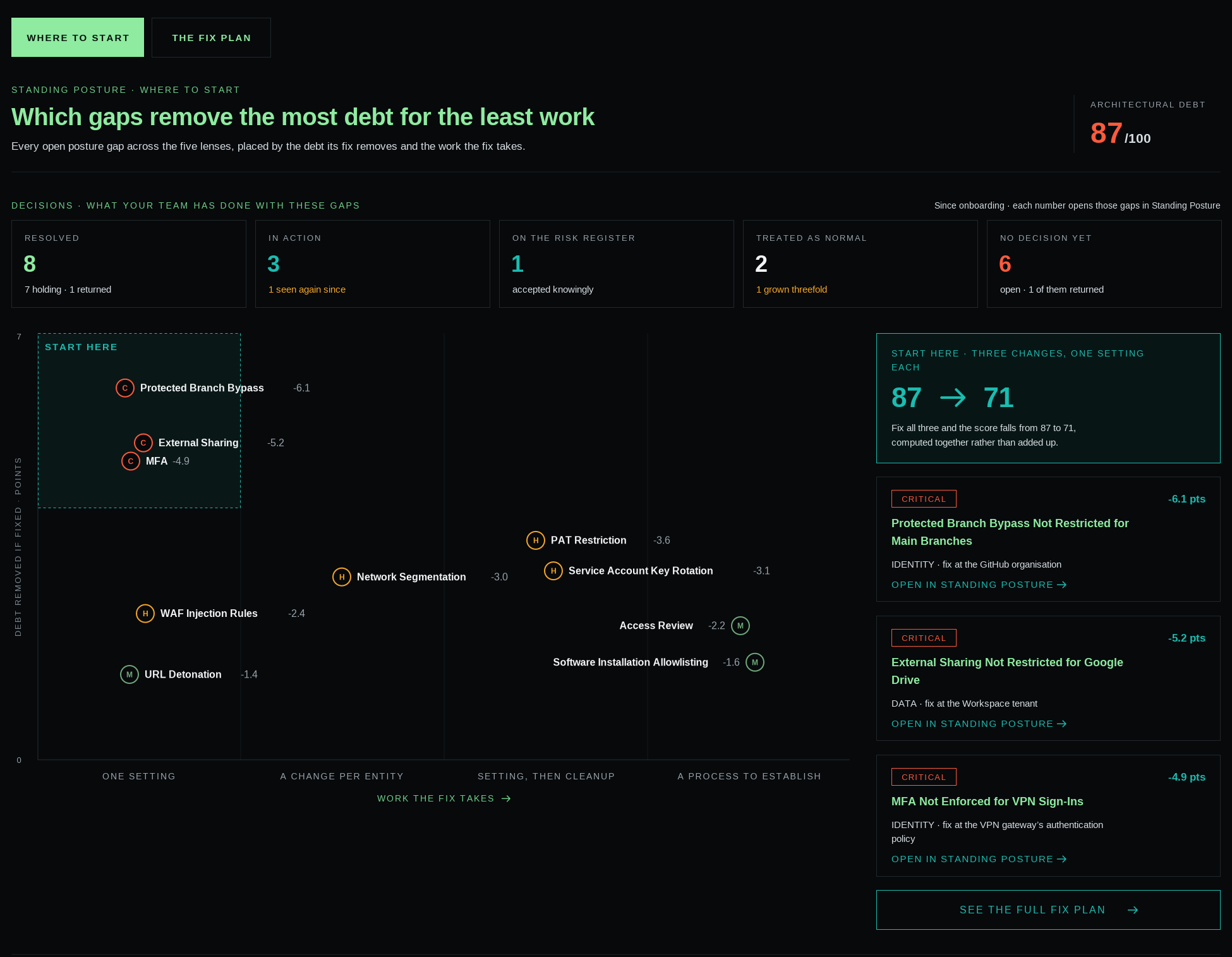
    Rivet Standing Posture, Where to start view: architectural debt 87 of 100; decisions since onboarding; a chart placing every open gap by the debt its fix removes against the work the fix takes; and three start-here fixes that together take the score from 87 to 71.

    Situational awareness

    Security is designed once. It is practiced every day.

    Generally missed by defenders.

    Always met by attackers.

    LAYER 1

    Design

    What you intend.

    Policies, configurations, access.

    READ BY AUDITS AND SCANNERS

    Generally missed by defenders. Always met by attackers.

    LAYER 2

    Practice

    SITUATIONAL AWARENESS

    What actually happens.

    Which paths get used, how privilege is exercised, how approvals really work.

    DERIVED BY RIVET

    LAYER 3

    Protection

    What actually holds.

    The design, as it survives the practice.

    ASSESSED BY RIVET, FROM THE PRACTICE

    Most programs inspect the first layer and hope it predicts the third. Rivet reads the second to assess the third.

    As designed As practiced As it holds
    A bastion mediates all administrative access. 25 admin sessions went around it in 88 days. FALLING SHORT
    Data-loss prevention protects mail and files. 55 flagged emails were delivered after a warning. FALLING SHORT
    Single sign-on governs access to code. 134 people reach code with static tokens instead. FALLING SHORT
    The identity perimeter resists password spraying. 315 attempts from 249 IPs. None succeeded. HOLDING

    The unknown

    Know the unknown. The debt accumulating in your security architecture.

    Some safeguards were never established. Some protect less than intended. Others no longer operate as they once did. Rivet surfaces all three.

    NEVER BUILT

    The gap no one designed for.

    WHY IT STAYS UNKNOWN

    There’s no control, so there’s nothing for an audit to check.

    HOW RIVET CATCHES IT

    It sees the environment using a path the architecture never planned for.

    158 peers

    One internal host reaching 158 others directly for 69 days.

    BUILT PARTWAY

    The gap inside a control you trust.

    WHY IT STAYS UNKNOWN

    The control exists and passes review. The weakness sits in what it was never set to cover.

    HOW RIVET CATCHES IT

    It sees what the control actually lets through.

    Log4j

    A web application firewall in front of public services, without rules for the Log4j exploit class.

    DRIFTED

    The gap that drifted from your design.

    WHY IT STAYS UNKNOWN

    It was true when it was verified, and nothing alerts when it stops being true.

    HOW RIVET CATCHES IT

    It sees access that remains long after the activity behind it has stopped.

    5 accounts

    Dormant service accounts still holding access to the environment.

    Environment-specific intelligence

    The same behavior. A different security meaning.

    Rivet develops an understanding of each organization’s operating patterns, safeguards, relationships and history. Its agents continuously interpret new evidence in that context, distinguishing expected activity from meaningful exposure.

    INTERACTIVE · ONE ACTION, TWO ENVIRONMENTS

    An engineer starts an interactive shell in a workload.

    OBSERVED ACTIVITY

    Interactive shell

    The same technical action in both environments: an interactive shell session started by an engineer.

    WHAT RIVET KNOWS ABOUT THIS ENVIRONMENT

      CONTEXTUAL CONCLUSION

      Illustrative scenario, not an actual Rivet assessment. The environmental details are hypothetical; the kinds of context are the ones Rivet uses.

      The questions every security leader carries. Rivet helps answer them with an understanding of how the environment actually operates.

      1. 01Do we know how our environment actually operates, and what that means for our protection?Where action actually is — which identities are active, which assets are touched, which paths are in use.
      2. 02Is what we set up still true?Configured once is not enforced today. Drift shows in behavior before it shows in an audit.
      3. 03What is relevant to us?Not a thousand benchmark findings — the conditions our own operations keep running into.
      4. 04Where is our “we’re fine” wrong?The suspicions we can name, and the blind spots we can’t.
      5. 05When something tests us, does it hold?Controls that held under real pressure, with the numbers — next to the ones that didn’t.
      6. 06Can we see cause and effect?The attempt and the condition that allowed or denied it, side by side.
      7. 07Are we getting better or worse?The same gap tracked week over week, from first seen until it closes.

      Which of your controls held this week — and which only exist on paper?

      Get a posture assessment

      Know Where
      You Stand.

      Bring a week of telemetry. We’ll show you what holds, what falls short and what is missing — in your environment, with the evidence.