
.png?width=337&height=172&name=Why%20wrong%20layer%20correlation%20drives%20(1).png)
Security Event Correlation: Why Wrong-Layer Rules Drive Alert Fatigue
.webp?width=30&name=Raju%20(1).webp) Raju Chekuri: 29/09/2026
Raju Chekuri: 29/09/2026
Digital Pulse: A Book by our CEO

Platform
Featured Videos

Digital Pulse: A Book by our CEO
Digital Pulse: A Book by our CEO
Published on July 7, 2026 | Last updated on July 20, 2026 | 2 min read
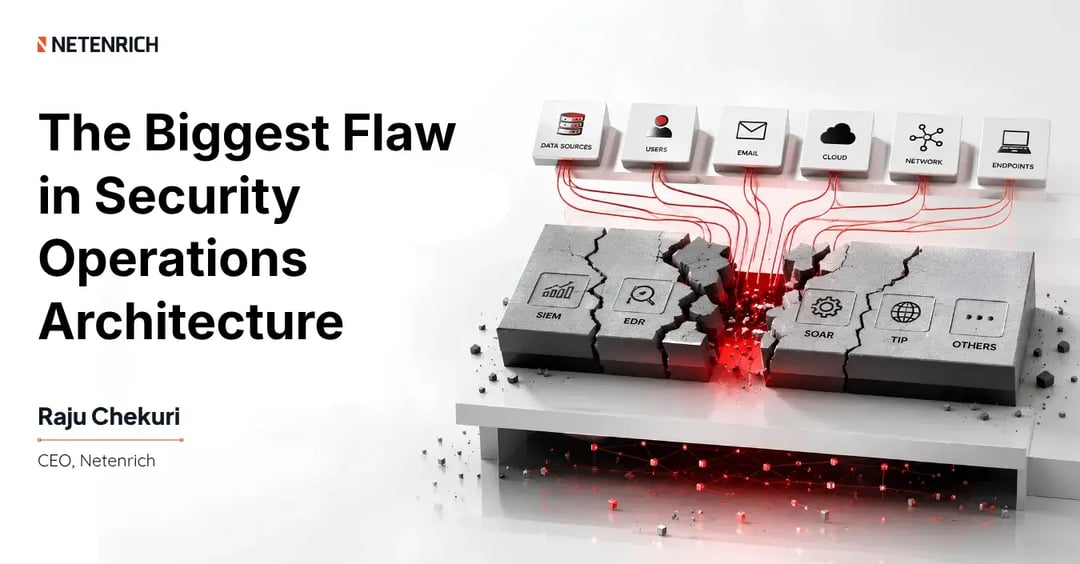
There is a structural mismatch at the heart of most enterprise security operations that I find myself returning to constantly. Understanding it clearly is, I believe, the prerequisite for addressing the core flaws within legacy security operations architecture.
Security operations centers are built around deterministic workflows. A detection condition is met. An alert is generated. An analyst follows a defined investigative process. The outcome - confirmed incident or false positive - is determined by the investigation. Ticket closed. Next alert.
Deterministic thinking applied to security: defined inputs produce defined outputs through defined processes. It is an efficient model for handling known threats at the scale modern enterprises require. Its fundamental limitation is equally clear: it can only address what the detection logic was designed to find. Anything outside that space generates no alert and triggers no response.
Adversaries operate differently. They approach a target enterprise with a goal and explore the attack surface systematically - not through any single defined process but through continuous experimentation. An approach that is blocked is abandoned and another is tried. An approach showing progress receives more investment. Multiple approaches run simultaneously. The adversary allocates effort toward the paths most likely to succeed given current conditions.
This is probabilistic thinking applied to offense: not "if X then Y" but "what are all the possible paths to my objective, what is the probability of success for each given what I know about this environment, and how do I systematically work through them?" The adversary does not stop when one approach fails. They are not constrained by shift schedules or SLA commitments. They are running a continuous optimization.
In 2026, generative AI has made this asymmetry more acute. Adversary reconnaissance is faster and more thorough - they arrive knowing more about the target environment. Social engineering is more convincing and more scalable. Technique iteration is quicker. The probabilistic exploration of attack paths has accelerated significantly while most defensive architectures have evolved more slowly.
The structural response cannot be adding more detection rules or more analysts processing alerts. Expanding your deterministic capability does not address the underlying probabilistic gap within your security operations architecture. The real solution is to introduce probabilistic thinking as a parallel mode within a modern SOC architecture. More deterministic capability does not address the probabilistic gap. The response is to introduce probabilistic thinking into security operations as a parallel mode: actively modeling what the adversary would most likely do given what you know about your specific environment and the current threat landscape, directing analytical attention toward those probable paths, and looking for evidence of activity in progress rather than waiting for detection to fire.
Data science enables this. Adversary path modeling identifies the highest-probability lateral movement routes. Behavioral analytics surfaces anomalies consistent with adversary approach patterns. Threat intelligence processed continuously updates the threat model that drives where you look.
Ready to evolve your security operations architecture past reactive alert triage? Deploy a Netenrich Agentic SOC in 30 Days to transition from static rules to autonomous threat modeling, achieving 98% autonomous resolution and an ironclad 3-minute triage SLA.

But data science is the tool. The intent to operate probabilistically has to come first. And that intent is a leadership decision, not a technology purchase.
*Part of my ongoing series on data science and the future of security operations.*
The best source of information for Agentic SOC and Cyber Risk Operations best practices. Join us.

.png?width=337&height=172&name=Security%20data%20pipeline%20OG%20Image%20(3).png)
.jpeg?width=337&height=172&name=Image%20(3).jpeg)