












_2013-11-24_16-00.png?width=1024&height=293&name=1024px-Tibco_logo-_Palo_Alto%2c_CA_company-_(PNG)_2013-11-24_16-00.png)







The Illusion
Green Dashboards Don’t Mean You’re Safe.
They Mean Nobody’s Checking.
Your vendor’s report says everything is fine. Tickets closed. SLAs met. But behind those metrics, your controls are tuned for threats that haven’t been relevant in 18 months. Your attack surface shifted with every deployment, cloud migration, and sprint. Your defenses didn’t move with it.
That gap is invisible in every dashboard. It’s also the exact gap adversaries exploit.
.png?width=36&height=36&name=svgviewer-png-output%20(3).png)
Dropped Logs, Hidden Gaps
Your MDR drops logs to protect their margins. You’re paying for coverage you’re not getting.

Static Rules, Dynamic Threats
One-size-fits-all use cases across every customer. None of them reflect your environment.
.png?width=36&height=36&name=svgviewer-png-output%20(1).png)
No Cloud or Production Visibility
Your MDR can’t keep up with cloud environments that change multiple times a day.
.png?width=36&height=36&name=svgviewer-png-output%20(2).png)
The Black Box
You hand over your data and wait for a ticket. You appear to have control, but you don’t.
The Math
You Cannot Fight Machine-Speed Attacks with Human-Speed Triage.The Math Is Broken.
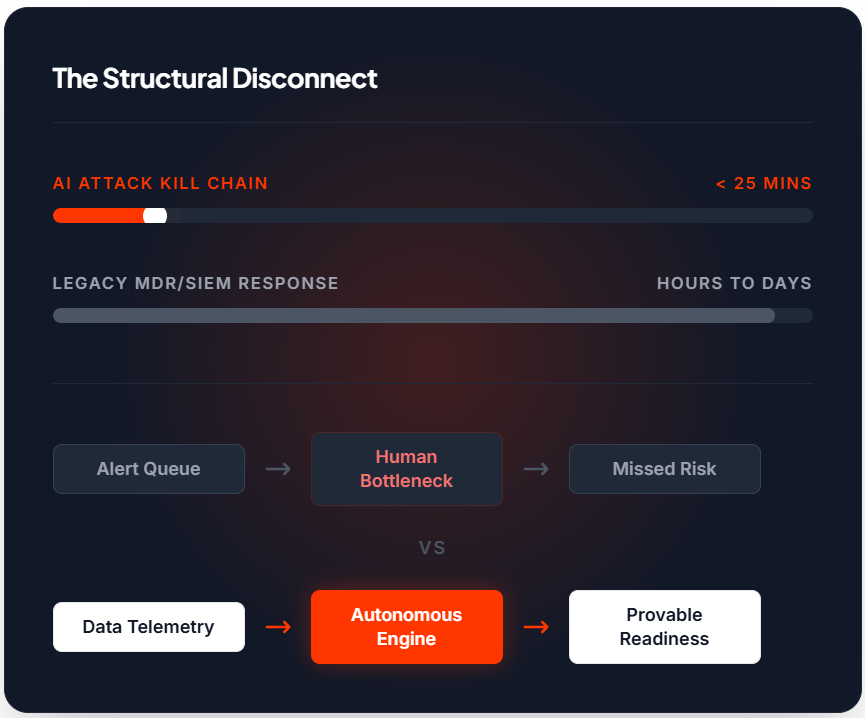
AI-driven adversaries execute their full kill chain in under 25 minutes. Your MDR responds at human speed - hours, sometimes days. Your SIEM processes data from a world that no longer exists. The model isn’t slow. It’s structurally incapable of defending you.
Every vendor in your pipeline - the MDRs, the “AI SOCs,” the legacy SIEMs - is optimizing for the same thing: faster triage of misaligned alerts.
Faster processing of the wrong signal doesn’t make you safer. It makes you faster at being wrong.

Version One: The Status Quo
You present dashboards, ticket counts, and SLAs. The board nods. Everyone feels safe. Meanwhile, the gap between your controls and your actual threats continues to widen in absolute silence.

Version Two: Provable Readiness
You present evidence. Proof that your defenses are actively stopping the specific threats targeting your organization. Proof that your blind spots have been mapped and closed. Proof that your team moved from reactive triage to provable readiness - in 90 days.